Call Us for Support
+91 9654860915
Google Reviews
4.8
Call Us for Support
+91 9654860915

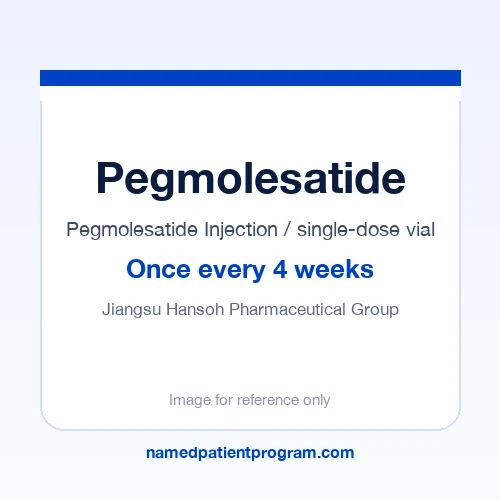
Sourced directly from the authorized manufacturer network to ensure authenticity and quality.
Ready to proceed? Start a request for Pegmolesatide on our secure patient portal to submit your prescription, upload documents and track your approval status.
Supplied with complete CDSCO-approved import and customs documentation, including Form 12A & 12B, CDEC, GST Bill of Entry, Commercial Invoice, and Packing List.
Manufacturer / Innovator:
China
Regulatory Approval:

Your Trustworthy Partner For Named Patient Program

Over a decade of trusted expertise in Named Patient Access to innovative and life-saving medicines.

100% CDSCO-compliant processes ensuring safe, ethical, and responsible medicine access.

Medicines sourced from authorized manufacturers with full batch traceability.

EU-GDP compliant warehousing for secure, quality-controlled global distribution.

Temperature-controlled logistics ensuring safe, reliable, and timely medicine delivery.
Pegmolesatide is a once-a-month injection for anaemia caused by chronic kidney disease (CKD). It was developed in China by Jiangsu Hansoh Pharmaceutical Group, where it is sold as 圣罗莱®. During development it was known as HS-20039, and earlier as pegol-sihematide or EPO-018B.
China's National Medical Products Administration (NMPA) approved it in June 2023 as a Class 1 innovative drug for anaemia in adults with CKD who are:
It is not a replacement for a blood transfusion when anaemia needs to be corrected straight away. It is a prescription kidney care medicine and should only be used under a nephrologist.
Healthy kidneys make a hormone called erythropoietin (EPO), which tells the bone marrow to make red blood cells. When the kidneys fail, EPO levels fall and anaemia follows. Pegmolesatide is a man-made peptide, not a copy of the EPO protein, that switches on the same EPO receptor on bone marrow cells. A polyethylene glycol (PEG) chain makes it last long enough to be injected just once every four weeks. Because it does not look like the EPO protein, it is not expected to trigger antibodies against the body's own EPO. It is currently the only EPO-mimetic peptide on the market.
People on dialysis: a phase 3 trial at 43 dialysis centres in China, published in eClinicalMedicine in 2023, switched 372 patients either to monthly pegmolesatide or to continue a comparison epoetin given one to three times a week. Haemoglobin stayed stable on pegmolesatide (an average change of +0.07 g/dL) and dipped slightly on the comparison treatment (−0.22 g/dL), so the monthly injection was at least as effective.
People not on dialysis: in a second phase 3 trial of 173 patients at 38 centres, published in Kidney International Reports in 2025, haemoglobin rose by an average of 19.2 g/L on pegmolesatide compared with 15.4 g/L on a weekly or fortnightly comparison epoetin.
According to the Chinese prescribing information, it is injected under the skin once every 4 weeks and must not be given into a vein. Other causes of anaemia, such as vitamin deficiency, bleeding or inflammation, should be corrected or ruled out first. The usual haemoglobin (Hb) target is 10.0 to 12.0 g/dL.
The label notes that patients whose Hb is stable on a short-acting epoetin may see noticeable Hb swings after switching, so the benefit and risk of switching should be weighed carefully. No dose change is needed for older people; there are no data in children under 18 or in people with liver impairment. Your nephrologist will follow the full dosing table on the label and adjust it to your blood tests.
This information is not a treatment plan. For personalized medical advice, consult your doctor and refer to the full prescribing information.
Blood pressure: high blood pressure was the most common side effect linked to the medicine. In the dialysis trial it affected 10.6% of patients on pegmolesatide and 9.7% on the comparison epoetin. In the non-dialysis trial, raised blood pressure judged to be treatment-related occurred in 5.2% (13.8% on the comparison). Your blood pressure will be checked regularly, and blood pressure medicines may need adjusting.
Overall: in the dialysis trial, serious health events occurred in 24.0% of patients on pegmolesatide and 21.8% on the comparison treatment, which reflects how unwell people on dialysis often are. Safety in pregnancy, breastfeeding and children has not been established in the published trials, so discuss this with your doctor first.
Step 1 – Search & request your medicine: The patient or treating doctor submits a request with basic details to initiate the access process.
Step 2 – Verification & eligibility review: The team verifies availability and reviews eligibility against regulatory and clinical requirements to ensure a compliant pathway.
Step 3 – Receive quote & delivery timeline: A transparent quotation is shared, covering medicine cost, logistics, and a clear delivery timeline.
Step 4 – Regulatory approval process: Assistance is provided to secure the approvals and documentation required for legal cross-border access.
Step 5 – Temperature-controlled import & handling: The medicine is sourced and transported under strict GDP-compliant, cold-chain conditions to maintain product integrity.
Step 6 – Secure delivery: The medicine is delivered to the patient or treating hospital, with updates provided at each stage.
Note: From request to delivery, every step is designed to ensure your treatment reaches you safely, compliantly, and without unnecessary delays.
The injection can be imported only in the patient's name, by the patient or a government hospital, in line with India's import regulations for unapproved medicines. You will need:
Once we have received and checked a valid prescription and, where needed, an import permit.
No. It is approved only in China. It has no CDSCO approval, it is not sold in Indian pharmacies, and the US FDA and European Medicines Agency have not approved it either.
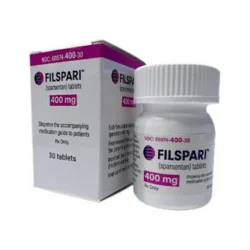
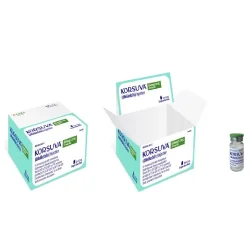
Patients can still get it legally through the Named Patient Program (NPP), which allows a medicine not registered in India to be imported for one specific patient on a prescription. For other kidney-related import pages, see Korsuva (itching linked to haemodialysis) and Filspari (IgA nephropathy).
It can be made available to patients, doctors, and hospitals across major cities in India, including Gurgaon, Delhi, Bangalore, Mumbai, Navi Mumbai, Thane, Hyderabad, Mysore, Kerala, Chennai, Coimbatore, Madurai, Kolkata, Ahmedabad, Surat, Vadodara, Pune, Nagpur, Nashik, Jaipur, Udaipur, Lucknow, Kanpur, Gorakhpur, Chandigarh, Mohali, Faridabad, Noida, Ghaziabad, Kochi, Trivandrum, Kozhikode, Thrissur, Kannur, Mangalore, Bhubaneswar, Patna, Ranchi, Raipur, Guwahati, Visakhapatnam, Vijayawada, Goa, Jammu, Srinagar, Dehradun, Bhopal, Indore, Ludhiana, Amritsar, and others — and can facilitate delivery to the patient's treating hospital. Orders are confirmed only after receipt of a valid doctor's prescription and an import permit, where applicable.
NamedPatientProgram.com (NPP) sources this medicine through the manufacturer's authorised supply channels in China and arranges supply to patients, doctors, and hospitals under applicable legal provisions. The injections are kept and shipped exactly as directed on the Chinese pack, using temperature-controlled shipping to the dialysis unit, hospital or patient. As it is given only once every four weeks, we can plan each delivery well before the next dose is due. All prescriptions are dispensed and checked by registered pharmacists and dispatched from New Delhi, India, after legal requirements are fulfilled.
For the current cost in India and availability, contact NPP via WhatsApp at +91 98104 69557 | Toll-Free: 1800-1200-365 or email info@namedpatientprogram.com.
Patients across India can access this medicine through regulated import pathways, with delivery arranged to the treating hospital or dialysis unit on a valid specialist's prescription.
Kidney centres in Delhi treat dialysis patients from across North India, and our New Delhi dispatch point keeps transit times short.
Doses can be delivered directly to the dialysis unit in time for the monthly dose.
Nephrologists in Bangalore can request the medicine for a named patient, with the quote shared before anything is ordered.
Doctors in Chennai can send us the latest haemoglobin and kidney reports to start the import.
Because the dose is monthly, we schedule each delivery around the patient's dialysis or clinic day.
Shipments to Kolkata and the eastern states are packed to keep within the storage range printed on the pack.
Patients in Pune can use the same documented import route, with updates at each stage.
The treating nephrologist can share the prescription and treatment history with us to begin.
Patients treated at kidney units in Vellore can have each dose delivered to the hospital.
Serves patients from Punjab, Haryana and Himachal Pradesh, with delivery to the treating hospital.
We coordinate delivery to public and private dialysis centres across Uttar Pradesh.
Patients across Kerala can receive the medicine at their dialysis unit in Kochi and nearby cities.
Access can also be coordinated for patients in other Indian cities, subject to a valid prescription and regulatory requirements.

Written By
Nitin GoswamiDeputy Manager – Content & Social Media, Ikris Pharma Network
Sources: NMPA • CDSCO

Last Updated: 19 October 2026
Our specialists are here to guide you through every step of the medicine access process.
Mail Us At:
info@namedpatientprogram.comContact Us:
+91 9654860915Send us a message