Call Us for Support
+91 9654860915
Google Reviews
4.8
Call Us for Support
+91 9654860915

Sourced directly from the authorized manufacturer network to ensure authenticity and quality.
Ready to proceed? Start a request for Recombinant Human Albumin on our secure patient portal to submit your prescription, upload documents and track your approval status.
Supplied with complete CDSCO-approved import and customs documentation, including Form 12A & 12B, CDEC, GST Bill of Entry, Commercial Invoice, and Packing List.
Manufacturer / Innovator:
China
Regulatory Approval:

Your Trustworthy Partner For Named Patient Program

Over a decade of trusted expertise in Named Patient Access to innovative and life-saving medicines.

100% CDSCO-compliant processes ensuring safe, ethical, and responsible medicine access.

Medicines sourced from authorized manufacturers with full batch traceability.

EU-GDP compliant warehousing for secure, quality-controlled global distribution.

Temperature-controlled logistics ensuring safe, reliable, and timely medicine delivery.
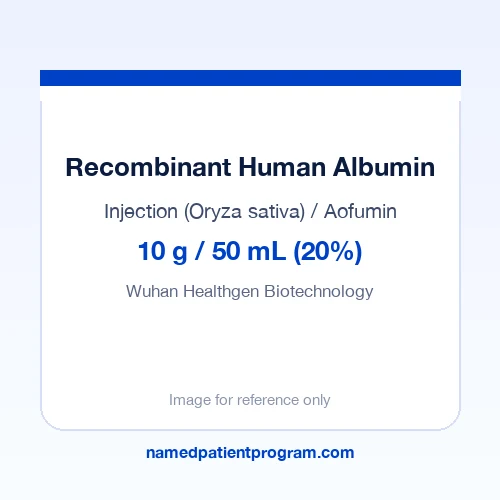
This is the first human albumin made without blood plasma. Wuhan Healthgen Biotechnology in China grows it in specially bred rice (Oryza sativa) that carries the human albumin gene, then extracts and purifies the protein. In China it is sold as 奥福民® under the official name 重组人白蛋白注射液(水稻), "recombinant human albumin injection (rice)". In research papers it is called OsrHSA.
China's National Medical Products Administration (NMPA) approved it in July 2025, after priority review, for one use:
It is a hospital liver medicine, given as a drip under a hepatologist or gastroenterologist.
Albumin is the main protein in blood. It holds fluid inside the blood vessels and carries many substances around the body. In cirrhosis the liver makes too little of it, which adds to fluid build-up in the belly (ascites) and swelling. A drip of albumin raises the level in the blood. Healthgen reports that its rice-made albumin has the same crystal structure as the human protein, a purity of over 99.9999%, and, because no plasma is used, no risk of passing on blood-borne infections.
In the phase 2 trial published in Gut in 2025, 220 people with decompensated cirrhosis and albumin of 30 g/L or less received 10 g or 20 g a day for up to two weeks. 76% of those on the rice-made albumin reached a level of 35 g/L, compared with 75.6% on plasma-derived albumin, which met the non-inferiority goal, and there were no drug-related serious side effects.
In the phase 3 trial, as summarised in China's drug review report, 326 patients received 20 g a day. 90.24% reached 35 g/L, against 95.68% with plasma-derived albumin, which was within the pre-set non-inferiority margin. Both groups took a median of 7 days to get there, and changes in ascites depth and blood osmotic pressure were similar.
In the trials, patients received 10 g or 20 g once a day (one or two 50 mL bottles), until albumin reached the target or for up to two weeks.
This information is not a treatment plan. For personalized medical advice, consult your doctor and refer to the full prescribing information.
Allergic reactions: it must not be used by anyone allergic to the active ingredient or any other ingredient, or with a past allergy to human albumin. Vital signs, urine output and blood tests are watched closely during the drip, because allergic reactions, including anaphylactic shock, can happen.
Side effects in the trials: each was uncommon. They included lower platelet counts (2.7%), protein in the urine (2.7%), low potassium (2.7%), low white cell and neutrophil counts (2.4% each), anaemia (2.4%), raised bilirubin (1.8%), itching (1.8%), allergic reactions (1.8%) and a longer QT interval on the ECG (1.2%). In 676 patients in the ongoing post-approval study, allergic reactions (1.48%) and fever (1.04%) were the most common. Safety in pregnancy, breastfeeding and children is not covered in the published summary, so discuss this with your doctor.
Step 1 – Search & request your medicine: The patient or treating doctor submits a request with basic details to initiate the access process.
Step 2 – Verification & eligibility review: The team verifies availability and reviews eligibility against regulatory and clinical requirements to ensure a compliant pathway.
Step 3 – Receive quote & delivery timeline: A transparent quotation is shared, covering medicine cost, logistics, and a clear delivery timeline.
Step 4 – Regulatory approval process: Assistance is provided to secure the approvals and documentation required for legal cross-border access.
Step 5 – Temperature-controlled import & handling: The medicine is sourced and transported under strict GDP-compliant, cold-chain conditions to maintain product integrity.
Step 6 – Secure delivery: The medicine is delivered to the patient or treating hospital, with updates provided at each stage.
Note: From request to delivery, every step is designed to ensure your treatment reaches you safely, compliantly, and without unnecessary delays.
The injection can be imported only in the patient's name, by the patient or a government hospital, in line with India's import regulations for unapproved medicines. You will need:
Once we have received and checked a valid prescription and, where needed, an import permit.
No. This rice-derived albumin is approved only in China. It has no CDSCO approval and is not sold in Indian pharmacies. It is not approved by the US FDA or the European Medicines Agency either; the company reports that a phase 3 trial is under way in the United States.
Patients can still get it legally through the Named Patient Program (NPP), which allows a medicine not registered in India to be imported for one specific patient on a prescription. For hepatitis C, one of the common causes of cirrhosis, see our page on Alfosbuvir.
It can be made available to patients, doctors, and hospitals across major cities in India, including Gurgaon, Delhi, Bangalore, Mumbai, Navi Mumbai, Thane, Hyderabad, Mysore, Kerala, Chennai, Coimbatore, Madurai, Kolkata, Ahmedabad, Surat, Vadodara, Pune, Nagpur, Nashik, Jaipur, Udaipur, Lucknow, Kanpur, Gorakhpur, Chandigarh, Mohali, Faridabad, Noida, Ghaziabad, Kochi, Trivandrum, Kozhikode, Thrissur, Kannur, Mangalore, Bhubaneswar, Patna, Ranchi, Raipur, Guwahati, Visakhapatnam, Vijayawada, Goa, Jammu, Srinagar, Dehradun, Bhopal, Indore, Ludhiana, Amritsar, and others — and can facilitate delivery to the patient's treating hospital. Orders are confirmed only after receipt of a valid doctor's prescription and an import permit, where applicable.
NamedPatientProgram.com (NPP) sources this medicine through the manufacturer's authorised supply channels in China and arranges supply to patients, doctors, and hospitals under applicable legal provisions. Each bottle holds 10 g of albumin in 50 mL (20%). The bottles must be kept at 2°C to 8°C and protected from light, so they travel under temperature-controlled shipping directly to the treating hospital. Quantities are planned from the dose your doctor prescribes. All prescriptions are dispensed and checked by registered pharmacists and dispatched from New Delhi, India, after legal requirements are fulfilled.
For the current cost in India and availability, contact NPP via WhatsApp at +91 98104 69557 | Toll-Free: 1800-1200-365 or email info@namedpatientprogram.com.
Patients across India can access this medicine through regulated import pathways, with delivery arranged to the treating hospital on a valid specialist's prescription.
Large liver institutes in Delhi treat cirrhosis patients from all over North India, and the short distance from our New Delhi base helps keep the cold chain tight.
Bottles are delivered refrigerated to the hospital pharmacy, ready for the infusion schedule set by the hepatologist.
Hepatologists in Bangalore can request it for a named patient, with the quote shared before anything is ordered.
Liver units in Chennai can send us the prescription and albumin report to begin a cold-chain import.
We plan the number of bottles around the daily dose so the course is not interrupted.
Shipments to Kolkata and eastern India are routed to stay between 2°C and 8°C all the way.
Hospitals in Pune can use the same documented import route, with updates at every stage.
Gastroenterologists in Ahmedabad can coordinate access for in-patients with cirrhosis and low albumin.
Serves patients from Punjab, Haryana and Himachal Pradesh, delivering to the treating hospital.
Hospitals in Rajasthan can receive refrigerated supply once the patient's documents are checked.
We coordinate cold-chain delivery to public and private liver units across Uttar Pradesh.
Hospitals in Kochi and across Kerala can receive the bottles in temperature-controlled packaging.
Access can also be coordinated for patients in other Indian cities, subject to a valid prescription and regulatory requirements.

Written By
Nitin GoswamiDeputy Manager – Content & Social Media, Ikris Pharma Network
Sources: NMPA • CDSCO

Last Updated: 19 October 2026
Our specialists are here to guide you through every step of the medicine access process.
Mail Us At:
info@namedpatientprogram.comContact Us:
+91 9654860915Send us a message