Call Us for Support
+91 9654860915
Finding access to medicine unapproved in your home country can feel overwhelming. We’re here to help you navigate the process, from your initial request to procurement coordination.
Submit your details and prescription to get started.Register today to get started on your medicine access journey.
Sourced directly from the authorized manufacturer network to ensure authenticity and quality.
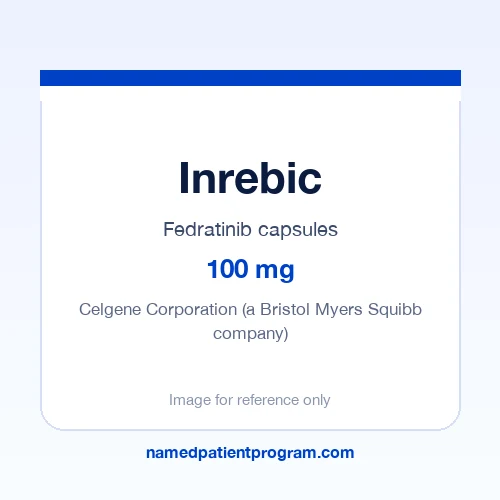
Ready to proceed? Order Inrebic on our secure patient portal to submit your prescription, upload documents and track your approval status.
Supplied with complete CDSCO-approved import and customs documentation, including Form 12A & 12B, CDEC, GST Bill of Entry, Commercial Invoice, and Packing List.
Manufacturer / Innovator:
Celgene Corporation (a Bristol Myers Squibb company)
Regulatory Approval:
Your Trustworthy Partner For Named Patient Program
Over a decade of trusted expertise in Named Patient Access to innovative and life-saving medicines.
100% CDSCO-compliant processes ensuring safe, ethical, and responsible medicine access.
Medicines sourced from authorized manufacturers with full batch traceability.
EU-GDP compliant warehousing for secure, quality-controlled global distribution.
Temperature-controlled logistics ensuring safe, reliable, and timely medicine delivery.
Inrebic (fedratinib) is a capsule for myelofibrosis, a rare bone marrow cancer in which scar tissue replaces normal marrow. This often causes a very large spleen, anaemia, night sweats, itching, bone pain and tiredness.
In the United States it is approved for adults with intermediate-2 or high-risk myelofibrosis, whether primary or secondary (developing after polycythaemia vera or essential thrombocythaemia). In the European Union it is approved to treat the enlarged spleen or symptoms of myelofibrosis in adults who have not had a JAK inhibitor before, and in adults who have already been treated with another JAK inhibitor.
It is a prescription blood cancer medicine started and monitored by a haematologist.
In myelofibrosis and related bone marrow cancers, abnormal activation of a signalling protein called JAK2 drives the disease. Fedratinib is an oral kinase inhibitor that selectively blocks JAK2 (and also FLT3). This helps shrink the spleen and ease symptoms.
In the JAKARTA study, 289 patients with intermediate-2 or high-risk myelofibrosis and an enlarged spleen were given Inrebic or a placebo. After six 4-week cycles, 37% of patients on Inrebic 400 mg had their spleen volume shrink by at least 35%, against 1% on placebo. For those who responded, the spleen response lasted a median of 18.2 months. 40% of patients on Inrebic had their symptom score fall by at least half, against 9% on placebo.
The usual dose is 400 mg (four 100 mg capsules) once a day by mouth, with or without food, for patients whose platelet count is at least 50 × 109/L. Taking it with a high-fat meal may reduce nausea. If a dose is missed, take the next dose the following day as normal.
Every patient must also take thiamine (vitamin B1) 100 mg a day, and thiamine is tested before starting. The dose is lowered with some other medicines (strong CYP3A4 inhibitors) and in severe kidney problems. For patients who cannot swallow capsules, the label allows the contents to be mixed in a liquid nutritional supplement and taken within 2 hours. Patients switching from another JAK inhibitor must taper and stop it as their doctor directs before starting Inrebic.
This information is not a treatment plan. For personalized medical advice, consult your doctor and refer to the full prescribing information.
Serious brain damage from low thiamine (Wernicke's encephalopathy) has happened with Inrebic: serious cases in 1.3% of patients in the trials, and fatal in 0.16%. This is why thiamine is checked before treatment, low levels are corrected first, and every patient takes daily thiamine. Warning signs are unsteady walking, confusion, memory problems and eye problems such as double vision. If these appear, Inrebic is stopped at once and thiamine is given by injection.
New or worse severe anaemia occurred in 34% of patients, usually within the first 3 months, and 51% received a blood transfusion. Severe low platelets occurred in 12%. Blood counts are checked before starting and regularly during treatment.
These are the most common: diarrhoea in 66% of patients, nausea in 62% and vomiting in 39%, usually starting in the first days. The label advises anti-sickness medicine to prevent nausea and treating diarrhoea at the first sign. Thiamine levels are also watched, so tell your doctor if vomiting or diarrhoea does not settle.
Liver enzymes (ALT and AST) rose in about 4 in 10 patients, and severe rises in amylase or lipase were seen in 2% and 10%. These are checked regularly with blood tests.
Uveitis was seen in 4% of patients in later studies, usually after more than a year of treatment (median 14 months). Report eye pain, redness or blurred vision.
Another medicine of the same JAK inhibitor class increased the risk of heart attack, stroke, blood clots and some cancers in people with rheumatoid arthritis. Doctors weigh this risk, especially in smokers and people with heart risk factors.
Myelofibrosis symptoms can flare after stopping a JAK inhibitor. Only stop on your doctor's advice.
Animal studies showed harm to the unborn baby, so discuss pregnancy plans with the doctor. Do not breastfeed during treatment and for at least 1 month after the last dose.
This information is not a treatment plan. For personalized medical advice, consult your doctor and refer to the full prescribing information.
Inrebic is not sold in Indian pharmacies, so it is imported for one named patient at a time. One bottle of 120 capsules lasts 30 days at the usual 400 mg dose, so we plan the supply month by month.
Send the prescription with the daily dose, the planned months of treatment, and the latest blood count, as the starting dose depends on the platelet count.
A registered pharmacist checks the prescription, the myelofibrosis diagnosis (bone marrow biopsy, and the JAK2, CALR or MPL report if done) and the patient's ID, and tells you at once if anything is missing.
The Inrebic price in India is quoted for the number of bottles needed, plus freight and customs clearance. If the doctor lowers the dose, one bottle lasts longer, and we adjust the next order.
We prepare the Form 12A application to CDSCO under Rule 36 of the Drugs and Cosmetics Rules. CDSCO states the Form 12B permit is usually issued within one to two days and stays valid for six months.
Inrebic capsules are stored below 30°C, so they do not need a fridge but must be protected from Indian summer heat in transit.
We deliver to the patient's address on the permit or to the treating hospital, and remind you before the bottle runs out so treatment is not interrupted.
The permit step usually takes one to two working days once all documents are complete. We share the expected delivery date with the quote, as it depends on stock at source and the flight route.
No. Inrebic (fedratinib) has no marketing approval in India and is not sold in Indian pharmacies. We checked the published minutes of CDSCO's oncology and haematology expert committees from 2018 to November 2026, and fedratinib does not appear in them. It can still be imported legally for a named patient under Rule 36, with a Form 12A application and a Form 12B permit.
Inrebic comes as 100 mg capsules in bottles of 120. At 400 mg a day that is four capsules daily, so one bottle covers 30 days. People often search for the fedratinib 100 mg price, but the monthly cost depends on the dose the haematologist prescribes.
Not from an open online store, because a medicine without Indian approval cannot be sold off the shelf. The legal way is to send the prescription to NPP online, and we arrange the permit and import in the patient's name.
Patients from Nepal, Bangladesh, Bhutan, Sri Lanka and the Gulf can also ask us, subject to each country's import rules. Read our guide to Indian import regulations for the full legal process.
Inrebic is made by Celgene, a Bristol Myers Squibb company. As an Inrebic supplier in India under the named patient route, NPP buys it only through authorised channels and only after the patient's permit is issued, so every bottle can be traced to one patient and one prescription.
Store the capsules below 30°C in the original bottle. Keep them away from hot cars, kitchens and direct sun. We ship in insulated packs that protect against heat; see our temperature-controlled shipping.
Inrebic must be taken with daily thiamine (vitamin B1) 100 mg. The patient's doctor prescribes the thiamine separately; please make sure it is started before the first Inrebic dose.
A registered pharmacist matches every order with the prescription and the permit before it leaves New Delhi, and checks the expiry date covers the treatment period.
For the Inrebic cost in India and current availability, contact NPP via WhatsApp at +91 98104 69557 | Toll-Free: 1800-1200-365 or email info@namedpatientprogram.com.
Inrebic is taken at home, while blood counts and thiamine levels are checked at the haematology clinic. We deliver to the patient or the hospital, as the doctor prefers.
See how we arrange delivery of imported medicines to hospitals across India.
Our specialists are here to guide you through every step of the medicine access process.
Mail Us At:
info@namedpatientprogram.comContact Us:
+91 9654860915Send us a message