Call Us for Support
+91 9654860915
Finding access to medicine unapproved in your home country can feel overwhelming. We’re here to help you navigate the process, from your initial request to procurement coordination.
Submit your details and prescription to get started.Register today to get started on your medicine access journey.
Sourced directly from the authorized manufacturer network to ensure authenticity and quality.
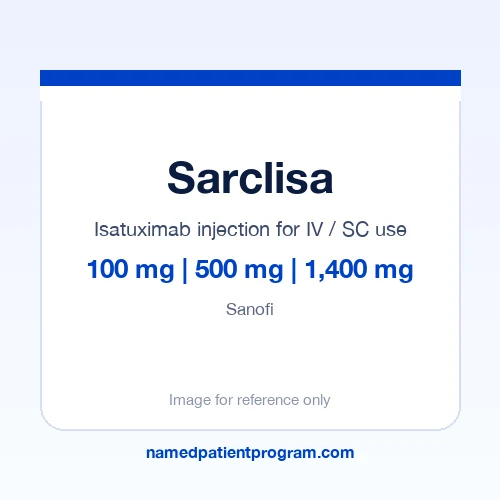
Ready to proceed? Order Sarclisa on our secure patient portal to submit your prescription, upload documents and track your approval status.
Supplied with complete CDSCO-approved import and customs documentation, including Form 12A & 12B, CDEC, GST Bill of Entry, Commercial Invoice, and Packing List.
Manufacturer / Innovator:
Sanofi
Regulatory Approval:
Your Trustworthy Partner For Named Patient Program
Over a decade of trusted expertise in Named Patient Access to innovative and life-saving medicines.
100% CDSCO-compliant processes ensuring safe, ethical, and responsible medicine access.
Medicines sourced from authorized manufacturers with full batch traceability.
EU-GDP compliant warehousing for secure, quality-controlled global distribution.
Temperature-controlled logistics ensuring safe, reliable, and timely medicine delivery.
Sarclisa (isatuximab) is an antibody medicine for multiple myeloma, a cancer of the plasma cells in the bone marrow. It is made by Sanofi and is always given together with other myeloma medicines, never on its own. In the United States it is approved for adults with multiple myeloma in three situations:
In the European Union it is also approved, since July 2025, as part of the first (induction) treatment for newly diagnosed patients who are going to have a stem cell transplant. It is a prescription blood cancer medicine and is given in hospital under a haematologist or medical oncologist.
Myeloma cells carry large amounts of a protein called CD38 on their surface. Sarclisa is a monoclonal antibody that sticks to CD38. This marks the myeloma cells so the immune system can find and destroy them, and it can also kill some of the cells directly.
Newly diagnosed, not for transplant (IMROZ): 446 patients took part. Adding Sarclisa to bortezomib, lenalidomide and dexamethasone cut the risk of the disease getting worse or death by 40% (hazard ratio 0.60). After a median follow-up of 60 months, the median time without progression had not yet been reached with Sarclisa, against 54.3 months without it. More patients reached a complete response (75% vs 64%), and 55% became MRD-negative, meaning no myeloma cells could be found even with a very sensitive test (41% without Sarclisa).
After 1 to 3 earlier treatments (IKEMA): in 302 patients, the final analysis showed a median of 41.7 months without progression with Sarclisa plus carfilzomib and dexamethasone, against 20.8 months with carfilzomib and dexamethasone alone.
After 2 or more treatments (ICARIA-MM): in 307 patients, the median time without progression was 11.5 months with Sarclisa plus pomalidomide and dexamethasone, against 6.5 months without it. Response rates were 60% against 35%.
Intravenous (IV) infusion: 10 mg per kg of body weight. With pomalidomide or carfilzomib, it is given once a week (Days 1, 8, 15 and 22) in the first 28-day cycle, then every 2 weeks (Days 1 and 15). With bortezomib, lenalidomide and dexamethasone, the first four cycles are 42 days long, with infusions on Days 1, 8, 15, 22 and 29 in Cycle 1 and every 2 weeks in Cycles 2 to 4. The first infusion is given slowly, and the speed is raised step by step if there is no reaction.
Subcutaneous (SC) injection: a newer form, Sarclisa for subcutaneous use (sold in the US as Sarclisa Escena), is a fixed 1,400 mg dose injected under the skin, usually with a small on-body injector. It was approved in the European Union in June 2026 and in the US in July 2026. The IV and SC forms have different doses and cannot be swapped vial for vial.
Medicines to prevent infusion reactions (such as paracetamol, an antihistamine and dexamethasone) are given before each dose. Your haematologist decides the exact plan.
This information is not a treatment plan. For personalized medical advice, consult your doctor and refer to the full prescribing information.
About 1 in 3 patients (35%) had an infusion reaction in the main trials, almost always during the first infusion. The most common signs are breathlessness and cough. Serious reactions, including anaphylaxis, are rare (under 1%) but can be life-threatening, which is why Sarclisa is only given in a hospital setting with pre-medicines and close monitoring.
Serious infections, mostly pneumonia, are common with Sarclisa-based treatment. In the trials, serious infections occurred in 46% of patients and were fatal in 4.7%. Report fever, cough or any sign of infection straight away. Your doctor may give medicines to prevent infections.
Neutrophil counts fell in 81% of patients and were severely low in 52%. Regular blood counts are needed, and a dose may be delayed until the count recovers.
Second cancers, mainly skin cancers, were seen more often with Sarclisa-containing treatment (12% of patients across the trials). Your doctor will check for them during follow-up.
Sarclisa can make the blood-bank cross-match test (indirect Coombs test) falsely positive for about 6 months after the last dose. A blood type and screen test should be done before the first dose. Always tell the blood bank that you are on Sarclisa if a transfusion is planned. It can also show up on the protein tests (SPEP and immunofixation) used to track myeloma, so your doctor may use a special test to confirm a complete response.
Sarclisa may harm an unborn baby. Women who can become pregnant should use effective contraception during treatment and for 5 months after the last dose. Lenalidomide and pomalidomide, which are often given with it, carry strict pregnancy rules of their own.
Upper respiratory infections, diarrhoea, tiredness and pneumonia were among the most common side effects. With carfilzomib, high blood pressure and breathlessness were also common, and patients should report any swelling of the legs or difficulty breathing (possible heart failure). With bortezomib and lenalidomide, nerve tingling (neuropathy) and cataract were also seen. This is not a complete list.
This information is not a treatment plan. For personalized medical advice, consult your doctor and refer to the full prescribing information.
Sarclisa is not sold in Indian pharmacies, so every order is arranged for one named patient. Because myeloma treatment with Sarclisa runs for months, we plan the supply cycle by cycle, not as a single purchase.
Send the prescription with the regimen (for example Sarclisa with carfilzomib and dexamethasone), the patient's current weight and the planned cycles. The IV dose is 10 mg/kg, so a 60 kg patient needs 600 mg per infusion. Our pharmacist works out the best mix of 100 mg and 500 mg vials, or confirms whether the doctor has prescribed the 1,400 mg subcutaneous form.
A registered pharmacist checks the prescription, the myeloma diagnosis reports and the patient's ID on the first day, and tells you at once if anything is missing.
Cycle 1 needs four or five doses, later cycles fewer, so the Sarclisa price in India is quoted for the vials actually needed, plus cold-chain freight and customs clearance.
We prepare the Form 12A application to CDSCO under Rule 36 of the Drugs and Cosmetics Rules. CDSCO states the Form 12B permit is usually issued within one to two days and stays valid for six months, so one permit can cover several cycles if the prescription says so.
The vials travel at 2°C to 8°C in their original cartons, with a temperature logger in every box.
We deliver to the hospital pharmacy or day-care unit where the patient receives the infusion, timed to the dosing days.
The permit step usually takes one to two working days once all documents are complete. We share the expected delivery date with the quote, as it depends on stock at source and the flight route.
Sarclisa is imported only in the patient's name. Please keep these ready:
Tip: ask the hospital to do the blood group and antibody screen before the first dose, because Sarclisa can affect this test for months.
No. Sarclisa (isatuximab) has no marketing approval in India and is not sold in Indian pharmacies. We checked the published minutes of CDSCO's oncology and haematology expert committees from 2018 to November 2026, and isatuximab has not come up for approval. It can still be imported legally for a named patient under Rule 36, with a Form 12A application and a Form 12B permit.
The IV form comes in two vials: 100 mg/5 mL and 500 mg/25 mL. The subcutaneous form is a single 1,400 mg/10 mL vial (green cap). Patients often search for the isatuximab 500 mg price, but the total cost depends on body weight, the regimen and the form prescribed. We confirm the vial plan in the quote.
Not from an open online store, because an unapproved medicine cannot be sold off the shelf in India. The legal way is to send the prescription to NPP online, and we arrange the permit and import in the patient's name.
Patients from Nepal, Bangladesh, Bhutan, Sri Lanka and the Gulf can also ask us, subject to each country's import rules. Read our guide to Indian import regulations for the full legal process.
Sarclisa is made by Sanofi. As a Sarclisa supplier in India under the named patient route, NPP buys it only through authorised channels and only after the patient's permit is issued. We do not keep it as open stock, so every vial can be traced to one patient and one prescription.
Unopened vials must be kept in a refrigerator at 2°C to 8°C, in the original carton to protect them from light. They must not be frozen or shaken. We ship them in validated insulated boxes with a data logger, and check the temperature record on arrival. Read more about our temperature-controlled shipping.
The hospital pharmacy dilutes the IV vials just before use. Per the US label, the prepared infusion bag can be kept for up to 48 hours in the fridge, followed by up to 8 hours at room temperature including the infusion time. A subcutaneous vial, once out of the fridge, must not go back in and can stay at room temperature for one period of up to 24 hours. This is why we time each delivery close to the dosing day.
A registered pharmacist matches every order with the prescription and the permit before it leaves New Delhi.
For the Sarclisa cost in India and current availability, contact NPP via WhatsApp at +91 98104 69557 | Toll-Free: 1800-1200-365 or email info@namedpatientprogram.com.
Sarclisa is given in hospital haematology and oncology day-care units, so we deliver to the hospital where the patient is treated. Because Cycle 1 has weekly doses, reliable cold-chain timing matters more than distance.
See how we arrange delivery of imported medicines to hospitals across India.
Our specialists are here to guide you through every step of the medicine access process.
Mail Us At:
info@namedpatientprogram.comContact Us:
+91 9654860915Send us a message