Call Us for Support
+91 9654860915
Finding access to medicine unapproved in your home country can feel overwhelming. We’re here to help you navigate the process, from your initial request to procurement coordination.
Submit your details and prescription to get started.Register today to get started on your medicine access journey.
Sourced directly from the authorized manufacturer network to ensure authenticity and quality.
Ready to proceed? Order Caprelsa on our secure patient portal to submit your prescription, upload documents and track your approval status.
Supplied with complete CDSCO-approved import and customs documentation, including Form 12A & 12B, CDEC, GST Bill of Entry, Commercial Invoice, and Packing List.
Manufacturer / Innovator:
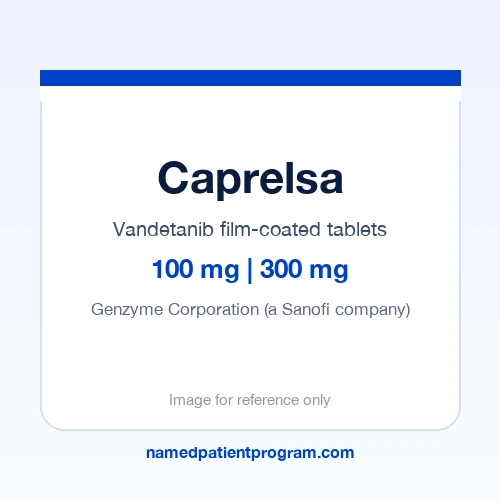
Genzyme Corporation (a Sanofi company)
Regulatory Approval:
Your Trustworthy Partner For Named Patient Program
Over a decade of trusted expertise in Named Patient Access to innovative and life-saving medicines.
100% CDSCO-compliant processes ensuring safe, ethical, and responsible medicine access.
Medicines sourced from authorized manufacturers with full batch traceability.
EU-GDP compliant warehousing for secure, quality-controlled global distribution.
Temperature-controlled logistics ensuring safe, reliable, and timely medicine delivery.
Caprelsa (vandetanib) is a once-daily tablet for medullary thyroid cancer (MTC), a rare cancer that starts in the C-cells of the thyroid gland. In the United States it is approved for symptomatic or progressive MTC that cannot be removed by surgery (unresectable), is locally advanced, or has spread to other parts of the body (metastatic).
Because of its heart risks, the US label asks doctors to use it in patients with slow-growing disease that causes no symptoms only after careful thought about the risks. In the European Union, Caprelsa is approved for aggressive and symptomatic MTC that carries a RET mutation, in adults and in children aged 5 years and older, and a validated RET test is needed before starting.
It is a prescription cancer medicine started by an oncologist or endocrine cancer specialist who can also monitor the heart.
Vandetanib is a kinase inhibitor. Lab studies show it blocks several growth signals at once, including RET, the VEGF receptors (which help tumours build new blood vessels) and the EGF receptor. In MTC, faulty RET signalling drives the growth of the cancer, so blocking it can slow the disease.
In the main study (331 patients with advanced MTC), Caprelsa 300 mg was compared with a placebo. It cut the risk of the cancer growing or death by 65% (hazard ratio 0.35). The median time without progression was 16.4 months on placebo and had not been reached with Caprelsa at the time of analysis. 44% of patients on Caprelsa had their tumours shrink, against 1% on placebo. Overall survival at the final analysis was similar in both groups, partly because most placebo patients later switched to Caprelsa.
The usual dose is 300 mg once a day by mouth, with or without food, until the disease progresses or side effects become too much. If side effects are severe, the doctor may lower the dose to 200 mg and then to 100 mg. Patients with moderate kidney problems start at 200 mg. It is not recommended for people with moderate or severe liver problems.
Do not crush the tablets. If swallowing is hard, a tablet can be stirred in about 60 mL of plain water for 10 minutes and drunk straight away (it will not fully dissolve); the same mix can go through a feeding tube. If a dose is missed, do not take it if the next dose is due within 12 hours.
This information is not a treatment plan. For personalized medical advice, consult your doctor and refer to the full prescribing information.
Caprelsa can lengthen the QT interval on the ECG. Torsades de pointes (a dangerous heart rhythm) and sudden death have happened in patients taking it. It must not be used in people with congenital long QT syndrome, or with low potassium, calcium or magnesium that has not been corrected. An ECG and blood tests for potassium, calcium, magnesium and TSH are needed at the start, at 2 to 4 weeks, at 8 to 12 weeks and then every 3 months. Many common medicines also lengthen the QT interval, so always show your full medicine list to the doctor.
Rash was seen in 53% of patients. Rare but serious reactions such as Stevens-Johnson syndrome have occurred, some fatal. The skin can burn easily in sunlight during treatment and for up to 4 months after stopping, so sun protection is important.
Diarrhoea occurred in 57% of patients and was severe in 11%. Because diarrhoea lowers salts in the blood, it also raises the heart-rhythm risk, so your doctor will check blood salts and ECG more often if it happens.
Interstitial lung disease, stroke, serious bleeding and heart failure, some fatal, have been reported. Report new breathlessness, cough, weakness on one side, or coughing up blood at once.
High blood pressure was seen in 33% of patients. Most patients with MTC have had their thyroid removed, and 49% on Caprelsa needed a higher dose of thyroid hormone, so TSH is checked regularly.
Caprelsa is stopped at least 1 month before planned surgery or dental surgery. Osteonecrosis of the jaw has been reported, so a dental check is advised before and during treatment.
Caprelsa can harm an unborn baby. Women who can become pregnant, and men with female partners, should use effective contraception during treatment and for 4 months after the last dose. Do not breastfeed during treatment and for 4 months after the last dose.
Nausea, acne-like rash, headache, tiredness, loss of appetite, stomach pain and upper respiratory infections. This is not a complete list.
This information is not a treatment plan. For personalized medical advice, consult your doctor and refer to the full prescribing information.
Caprelsa is not sold in Indian pharmacies, so it is imported for one named patient at a time. As it is taken every day for months, we plan the supply in monthly bottles.
Send the prescription with the dose (300 mg, 200 mg or 100 mg a day) and the planned length of treatment. The 300 mg dose uses 300 mg tablets; lower doses use 100 mg tablets, so the strength on the prescription decides which bottle we import.
A registered pharmacist checks the prescription, the MTC diagnosis (histopathology, and the RET mutation report if available) and the patient's ID, and tells you at once if anything is missing.
Each bottle holds 30 tablets, about one month of treatment. The Caprelsa price in India is quoted for the number of bottles needed, plus freight and customs clearance.
We prepare the Form 12A application to CDSCO under Rule 36 of the Drugs and Cosmetics Rules. CDSCO states the Form 12B permit is usually issued within one to two days and stays valid for six months.
Caprelsa tablets do not need a fridge. They travel sealed in their original bottles, protected from heat and moisture.
We deliver to the patient's home address on the permit or to the treating hospital, and plan the next bottle before the current one runs out.
The permit step usually takes one to two working days once all documents are complete. We share the expected delivery date with the quote, as it depends on stock at source and the flight route.
No. Caprelsa (vandetanib) has no marketing approval in India and is not sold in Indian pharmacies. We checked the published minutes of CDSCO's oncology and haematology expert committees from 2018 to November 2026, and no proposal to import or market vandetanib appears. It can still be imported legally for a named patient under Rule 36, with a Form 12A application and a Form 12B permit.
Caprelsa comes as 100 mg and 300 mg film-coated tablets, each in a bottle of 30. The usual starting dose is one 300 mg tablet a day. If the dose is lowered to 200 mg or 100 mg, 100 mg tablets are used. People often search for the vandetanib 300 mg price, but the total cost depends on the dose and the number of months prescribed.
Not from an open online store, because a medicine without Indian approval cannot be sold off the shelf. The legal way is to send the prescription to NPP online, and we arrange the permit and import in the patient's name.
Patients from Nepal, Bangladesh, Bhutan, Sri Lanka and the Gulf can also ask us, subject to each country's import rules. Read our guide to Indian import regulations for the full legal process.
Caprelsa is made by Genzyme, a Sanofi company. As a Caprelsa supplier in India under the named patient route, NPP buys it only through authorised channels and only after the patient's permit is issued, so every bottle can be traced to one patient and one prescription.
Store the tablets at room temperature, 20°C to 25°C; short periods between 15°C and 30°C are allowed. Keep them in the original bottle. In Indian summers this means keeping the bottle away from hot cars, kitchens and window sills. We ship in insulated packs that protect against heat; see our temperature-controlled shipping.
Caprelsa is an anticancer medicine, so the label asks for the usual safe handling and disposal of anticancer drugs. Do not crush the tablets, and return any unused tablets to the pharmacy rather than throwing them away.
A registered pharmacist matches every order with the prescription and the permit before it leaves New Delhi, and checks the expiry date covers the treatment period.
For the Caprelsa cost in India and current availability, contact NPP via WhatsApp at +91 98104 69557 | Toll-Free: 1800-1200-365 or email info@namedpatientprogram.com.
Caprelsa is taken at home, but the ECG and blood tests are done at the treating centre, so we deliver either to the patient or to the hospital, whichever the doctor prefers.
See how we arrange delivery of imported medicines to hospitals across India.
Our specialists are here to guide you through every step of the medicine access process.
Mail Us At:
info@namedpatientprogram.comContact Us:
+91 9654860915Send us a message