Call Us for Support
+91 9654860915
Google Reviews
4.8
Call Us for Support
+91 9654860915

Sourced directly from the authorized manufacturer network to ensure authenticity and quality.
Ready to proceed? Start a request for Keverprazan on our secure patient portal to submit your prescription, upload documents and track your approval status.
Supplied with complete CDSCO-approved import and customs documentation, including Form 12A & 12B, CDEC, GST Bill of Entry, Commercial Invoice, and Packing List.
Manufacturer / Innovator:
China
Regulatory Approval:

Your Trustworthy Partner For Named Patient Program

Over a decade of trusted expertise in Named Patient Access to innovative and life-saving medicines.

100% CDSCO-compliant processes ensuring safe, ethical, and responsible medicine access.

Medicines sourced from authorized manufacturers with full batch traceability.

EU-GDP compliant warehousing for secure, quality-controlled global distribution.

Temperature-controlled logistics ensuring safe, reliable, and timely medicine delivery.
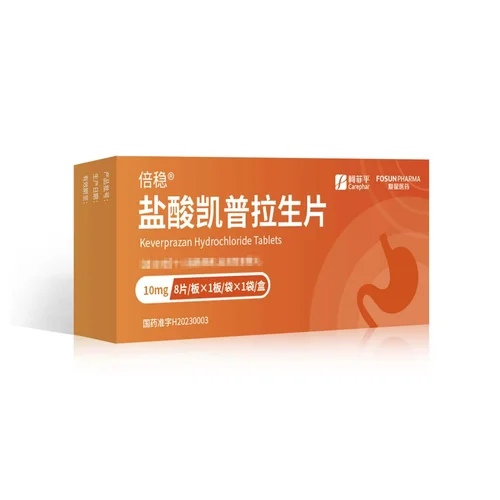
Keverprazan is a stomach acid blocker developed in China by Jiangsu Carephar Pharmaceutical and sold there as 倍稳® (Beiwen). It belongs to a newer group of acid-lowering medicines called potassium-competitive acid blockers, or P-CABs, and is taken as a tablet. In mainland China it is marketed together with Fosun Pharma.
China's National Medical Products Administration (NMPA) approved it in February 2023 for adults with:
In October 2024 a third use was added: getting rid of Helicobacter pylori, the stomach bacterium behind many ulcers, when it is combined with suitable antibiotics.
It is a prescription digestive health medicine and should be used under a gastroenterologist or physician.
The stomach makes acid with a tiny "pump" in its lining, the H+/K+-ATPase. Keverprazan blocks this pump by competing with potassium at the spot where the pump works. Unlike older proton pump inhibitors, it does not need acid to switch it on, and it can block pumps that are resting as well as those that are active. In a study in healthy volunteers, 20 mg a day kept stomach pH above 5 for 97.4% of the day by day 7.
According to the Chinese prescribing information, for adults:
Each tablet contains 10 mg, so a 20 mg dose is two tablets. The company reports that food does not have a significant effect on how it is absorbed. Your doctor decides the exact course.
This information is not a treatment plan. For personalized medical advice, consult your doctor and refer to the full prescribing information.
Gastrin levels: like other strong acid blockers, it raises gastrin, a hormone the stomach releases when acid is low. In the duodenal ulcer trial the average rise was clearly higher than with the comparison medicine (195 vs 64 pg/mL), but in most patients levels returned to normal within 4 weeks of stopping.
Overall: in the duodenal ulcer trial, side effects of any kind occurred in 57.8% of patients on keverprazan and 59.0% on the comparison medicine, mostly mild, with no deaths. In the H. pylori trial, no serious side effects were linked to the study medicines. It is approved for adults only, and its safety in pregnancy and breastfeeding has not been established in the published data, so discuss this with your doctor first.
Step 1 – Search & request your medicine: The patient or treating doctor submits a request with basic details to initiate the access process.
Step 2 – Verification & eligibility review: The team verifies availability and reviews eligibility against regulatory and clinical requirements to ensure a compliant pathway.
Step 3 – Receive quote & delivery timeline: A transparent quotation is shared, covering medicine cost, logistics, and a clear delivery timeline.
Step 4 – Regulatory approval process: Assistance is provided to secure the approvals and documentation required for legal cross-border access.
Step 5 – Temperature-controlled import & handling: The medicine is sourced and transported under strict GDP-compliant conditions to maintain product integrity.
Step 6 – Secure delivery: The medicine is delivered to the patient or treating hospital, with updates provided at each stage.
Note: From request to delivery, every step is designed to ensure your treatment reaches you safely, compliantly, and without unnecessary delays.
The tablets can be imported only in the patient's name, by the patient or a government hospital, in line with India's import regulations for unapproved medicines. You will need:
Once we have received and checked a valid prescription and, where needed, an import permit.
No. It is approved only in China. It has no CDSCO approval, it is not sold in Indian pharmacies, and the US FDA and European Medicines Agency have not approved it either.
Patients can still get it legally through the Named Patient Program (NPP), which allows a medicine not registered in India to be imported for one specific patient on a prescription. We also arrange Anaprazole, another acid-lowering medicine approved in China for duodenal ulcer.
It can be made available to patients, doctors, and hospitals across major cities in India, including Gurgaon, Delhi, Bangalore, Mumbai, Navi Mumbai, Thane, Hyderabad, Mysore, Kerala, Chennai, Coimbatore, Madurai, Kolkata, Ahmedabad, Surat, Vadodara, Pune, Nagpur, Nashik, Jaipur, Udaipur, Lucknow, Kanpur, Gorakhpur, Chandigarh, Mohali, Faridabad, Noida, Ghaziabad, Kochi, Trivandrum, Kozhikode, Thrissur, Kannur, Mangalore, Bhubaneswar, Patna, Ranchi, Raipur, Guwahati, Visakhapatnam, Vijayawada, Goa, Jammu, Srinagar, Dehradun, Bhopal, Indore, Ludhiana, Amritsar, and others — and can facilitate delivery to the patient's treating hospital. Orders are confirmed only after receipt of a valid doctor's prescription and an import permit, where applicable.
NamedPatientProgram.com (NPP) sources this medicine through the manufacturer's authorised supply channels in China and arranges supply to patients, doctors, and hospitals under applicable legal provisions. Each box holds 8 tablets of 10 mg, which is four days of treatment at 20 mg once a day. A 6-week duodenal ulcer course needs 11 boxes, an 8-week reflux esophagitis course 14 boxes, and a 14-day H. pylori course 7 boxes. The tablets travel in their sealed original packs under temperature-controlled shipping and should be stored as directed on the pack. All prescriptions are dispensed and checked by registered pharmacists and dispatched from New Delhi, India, after legal requirements are fulfilled.
For the current cost in India and availability, contact NPP via WhatsApp at +91 98104 69557 | Toll-Free: 1800-1200-365 or email info@namedpatientprogram.com.
Patients across India can access this medicine through regulated import pathways, with delivery arranged to the patient or the treating clinic on a valid specialist's prescription.
Gastroenterology clinics in Delhi see patients from across North India, and our New Delhi dispatch point means the tablets can reach them quickly.
Doctors in Mumbai can request the full course for a named patient in one order, so treatment is not interrupted halfway.
Patients in Bangalore can have the tablets delivered home or to their clinic once the prescription and endoscopy report are checked.
A long-established centre for digestive medicine in South India, where specialists can share the case details with us to start the import.
Gastroenterologists in Hyderabad can send the prescription and test reports, and we share a written quote before anything is ordered.
For Kolkata and the eastern states, we plan delivery so the course can start on the date the doctor has set.
Patients in Pune can use the same documented import route, with updates at every step.
Doctors in Ahmedabad can arrange access for patients who need this specific medicine, with the box count worked out from the prescribed course.
Patients from Jaipur and the rest of Rajasthan can receive the tablets at home or at their treating clinic.
Serves patients from Punjab, Haryana and Himachal Pradesh, with delivery to the patient or the treating clinic.
We coordinate delivery to patients and hospitals across Uttar Pradesh after the paperwork is complete.
Patients across Kerala can receive the medicine in Kochi and nearby cities.
Access can also be coordinated for patients in other Indian cities, subject to a valid prescription and regulatory requirements.

Written By
Nitin GoswamiDeputy Manager – Content & Social Media, Ikris Pharma Network
Sources: NMPA • CDSCO

Last Updated: 19 October 2026
Our specialists are here to guide you through every step of the medicine access process.
Mail Us At:
info@namedpatientprogram.comContact Us:
+91 9654860915Send us a message