

Ovarian Cancer Medicines in India: Imported Options Matched to Platinum Response and Test Results
Ovarian cancer in India: what the numbers show
GLOBOCAN puts the number of Indian women living with an ovarian cancer diagnosis made in the previous five years at 106,187 [1]. Across the world, an estimated 330,731 women were diagnosed in 2024, and 203,850 died of the disease [2]. Indian hospital series add detail that global figures miss:
- SKIMS, Srinagar (Kashmir): the median age was 50, and 76.9% of women with epithelial ovarian cancer already had stage III or IV disease when they reached the hospital. Bloating or a swollen abdomen (46.5%) and stomach or bowel complaints (35.2%) were the commonest first symptoms [5].
- Nine centres across India: among 239 women tested by next-generation sequencing, the median age was 53. A harmful BRCA change was found in 20 of 90 women aged 50 or younger and in 31 of 149 older women, so age alone is a poor guide to who carries one [3].
- Six centres in a national registry (2022–2023): in women whose cancer did not respond to the first platinum course, median progression-free survival was 4.75 months from diagnosis, and only 6.5% received any maintenance treatment [4].
Because symptoms are vague and appear late, a woman with lasting bloating, early fullness after meals or pelvic discomfort should see a gynaecologist rather than wait.
Two questions that decide which medicine fits
After surgery and platinum chemotherapy, oncologists group ovarian cancer by how it behaved on platinum. If it shrank and stayed controlled, the aim is to keep it in check with maintenance tablets. If it grew during platinum or came back within six months of finishing it, doctors call it platinum-resistant [4], and a different set of medicines applies.
| Situation | Test that matters | Medicines on this page |
|---|---|---|
| Advanced cancer that responded to first-line platinum | HRD status (a BRCA mutation and/or genomic instability) for Zejula; the Chinese approval of Senaparib does not list a BRCA or HRD condition | Zejula, Senaparib |
| Relapsed cancer that responded again to platinum | Inherited (germline) BRCA mutation | Zejula |
| Platinum-resistant cancer after 1 to 3 earlier treatment regimens | FRα expression on the tumour, measured with an FDA-approved test | Elahere |
| Platinum-resistant cancer after 1 to 3 earlier regimens, one of them with bevacizumab | No biomarker test required by the label | Lifyorli, taken with nab-paclitaxel |
In the Indian BRCA study, 40 of 159 serous tumours (25.2%) and 11 of 80 non-serous tumours (13.8%) carried a mutation [3]. An inherited mutation can be passed on in the family, so a genetic counsellor can help relatives decide on their own testing.
Imported ovarian cancer medicines by type
All 4 medicines below are prescription-only. Tap a type to filter. Each card opens the full medicine page with dosage, storage and safety details.


Compare all 4 ovarian cancer medicines
| Medicine | Generic name | Ovarian cancer type | Form | Approved by |
|---|---|---|---|---|
| Zejula | niraparib | PARP maintenance | Capsule | US FDA |
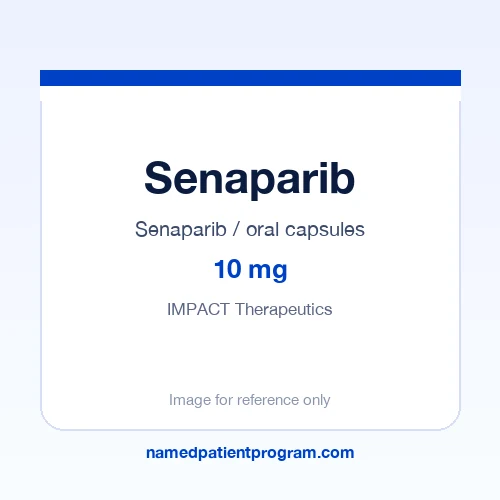
| Senaparib | senaparib | PARP maintenance | Capsule | China NMPA |
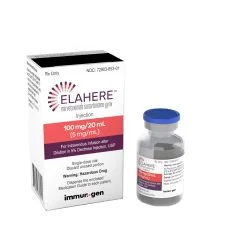
| Elahere | mirvetuximab soravtansine-gynx | Platinum-resistant | IV infusion | US FDA |
| Lifyorli | relacorilant | Platinum-resistant | Capsule | US FDA |
Reports your oncologist will want to see first
Each of these medicines is approved for a defined stage of treatment, so the prescription usually rests on the following papers:
| Report | Why it is needed | Linked medicines |
|---|---|---|
| Histopathology from biopsy or surgery | Confirms an epithelial cancer of the ovary, fallopian tube or peritoneum, and its grade | All |
| Chemotherapy history with dates | Shows the response to platinum and how many regimens were given before | All |
| BRCA or HRD test report | First-line Zejula maintenance needs HRD-positive status; later-line Zejula needs a germline BRCA mutation | Zejula |
| FRα immunohistochemistry result | Elahere is only for FRα-positive tumours | Elahere |
| Record of earlier bevacizumab | Lifyorli's approval requires at least one prior regimen that included bevacizumab | Lifyorli |
| Baseline eye examination | Elahere's US label has a boxed warning about damage to the eyes and requires an eye check, including a slit-lamp exam, before the first dose | Elahere |
Approvals based on a gene change rather than on the organ
A few US approvals cover any solid tumour that carries a particular change, generally when it has spread or cannot be removed safely and other treatment has failed or no satisfactory alternative is left. They are not specific to ovarian cancer but can be relevant when a sequencing report shows one of these findings: mismatch repair deficiency (Jemperli, accelerated approval), an NTRK gene fusion (Vitrakvi, also Rozlytrek and Augtyro), or a BRAF V600E mutation (Tafinlar together with Mekinist, accelerated approval). Your oncologist decides whether such an option makes sense.
Permit, cold-chain delivery and cost support for these medicines
Each pack is imported for one named patient. Our pharmacist drafts the Form 12A application for the patient, who then submits it to CDSCO, and CDSCO issues the import permit on Form 12B; the documents are listed on our page on Form 12A and 12B permits. Elahere is an intravenous infusion given in hospital, so it can travel at 2–8 °C with a temperature logger straight to the hospital pharmacy through our hospital delivery service. Zejula, Senaparib and Lifyorli are capsules taken by mouth.
PARP maintenance can last for years, which makes the total cost a real concern for families. The patient support and access programs page collects manufacturer programs, government schemes and charitable help that may lower it.
How to get these ovarian cancer medicines in India
Prescription
Your oncologist prescribes the medicine.
Share documents
Send the prescription and latest reports through Online Order.
Import paperwork
Our team checks the source and the import permissions.
Delivery
Delivered with the right storage, including cold chain.
Read How to Order and Indian import regulations. We also serve patients in Delhi NCR, Bangalore, Chennai, Mumbai, Kolkata and Hyderabad.
Has your oncologist prescribed one of these medicines?
Share the prescription and we will guide you on availability and next steps.
Read more about ovarian cancer
- Platinum-resistant ovarian cancer: symptoms, causes and treatment
- Zejula (niraparib) maintenance therapy: what ovarian cancer patients should know
- All Oncology medicines
References
- IARC Global Cancer Observatory. GLOBOCAN 2024 – India fact sheet (September 2026). https://gco.iarc.who.int/media/globocan/factsheets/populations/356-india-fact-sheet.pdf
- IARC Global Cancer Observatory. GLOBOCAN 2024 – Ovary fact sheet. https://gco.iarc.who.int/media/globocan/factsheets/cancers/25-ovary-fact-sheet.pdf
- Gupta S et al. Prevalence of BRCA1 and BRCA2 mutations among patients with ovarian, primary peritoneal, and fallopian tube cancer in India: a multicenter cross-sectional study. JCO Glob Oncol. 2021;7:849-861. https://pubmed.ncbi.nlm.nih.gov/34101484/
- Sehrawat A et al. Primary platinum-resistant ovarian cancer: clinicopathologic correlates and outcomes from a multicenter prospective Indian registry. JCO Glob Oncol. 2026;12(5):e2500650. https://pubmed.ncbi.nlm.nih.gov/42202250/
- Meena RK et al. Patterns of treatment and outcomes in epithelial ovarian cancer: a retrospective North Indian single-institution experience. JCO Glob Oncol. 2022;8:e2200032. https://pubmed.ncbi.nlm.nih.gov/36332174/
- US FDA prescribing information for each US-approved medicine (DailyMed). https://dailymed.nlm.nih.gov/dailymed/
This page gives general information only and does not replace medical advice. All medicines listed are prescription-only and must be used under a qualified oncologist.