Ikris Pharma
About Us Named Patient Program
Cities We Serve Contact Us
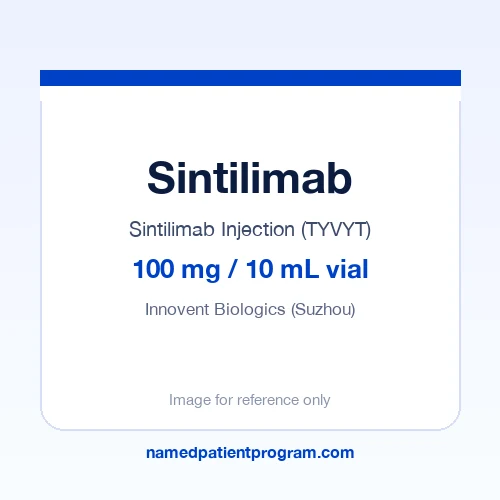
Sintilimab

Sourced directly from the authorized manufacturer network to ensure authenticity and quality.

Ready to proceed? Order Sintilimab on our secure patient portal to submit your prescription, upload documents and track your approval status.

Sintilimab

Supplied with complete CDSCO-approved import and customs documentation, including Form 12A & 12B, CDEC, GST Bill of Entry, Commercial Invoice, and Packing List.

Medicine Name: Sintilimab
Generic Name (API): Sintilimab
Dosage Form & Strength: 100 mg/10 mL
Route: Intravenous (IV) infusion
Drug Class: Fully human IgG4 anti-PD-1 monoclonal antibody (immune checkpoint inhibitor)

Manufacturer / Innovator:

Innovent Biologics (Suzhou) Co., Ltd.

Regulatory Approval:

  • NMPA (China)
Family enjoying life with Named Patient Program access

Your Trustworthy Partner For Named Patient Program

  • your trusted partner for named patient program

    Over a decade of trusted expertise in Named Patient Access to innovative and life-saving medicines.

  • 100% CDSCO-compliant processes ensuring safe, ethical, and responsible medicine access.

    100% CDSCO-compliant processes ensuring safe, ethical, and responsible medicine access.

  • Medicines sourced from authorized manufacturers with full batch traceability

    Medicines sourced from authorized manufacturers with full batch traceability.

  • EU-GDP Compliant Warehousing for secure, quality-controlled global distribution.

    EU-GDP compliant warehousing for secure, quality-controlled global distribution.

  • Temperature-Controlled Logistics for Safe and Timely Delivery

    Temperature-controlled logistics ensuring safe, reliable, and timely medicine delivery.

GDP Compliant View Certificate
Licensed Wholesale distributor View Certificate

What Is Sintilimab Used For?

Sintilimab is an immunotherapy drip used for several cancers, from Hodgkin lymphoma to lung, liver, oesophageal and stomach cancer. It is made in China by Innovent Biologics (Suzhou) Co., Ltd., which developed it together with Eli Lilly, and it is sold there under the brand name TYVYT® (达伯舒).

China's National Medical Products Administration (NMPA) first approved it in December 2018 for classical Hodgkin lymphoma. The current Chinese label lists these uses:

  • Classical Hodgkin lymphoma that has relapsed or not responded after at least two lines of systemic chemotherapy (used on its own)
  • Non-squamous non-small cell lung cancer (NSCLC): first-line, with pemetrexed and platinum chemotherapy, when the tumour has no EGFR or ALK change; and, for EGFR-mutated tumours that have stopped responding to EGFR tablets, with an anti-VEGF antibody plus chemotherapy
  • Squamous NSCLC: first-line, with gemcitabine and platinum chemotherapy
  • Liver cancer (hepatocellular carcinoma): first-line, with an anti-VEGF antibody, in people who have had no earlier systemic treatment
  • Oesophageal squamous cell cancer and stomach or gastro-oesophageal junction adenocarcinoma: first-line, with chemotherapy, when the cancer cannot be removed by surgery
  • Advanced pMMR endometrial cancer after earlier systemic treatment, and kidney cancer (renal cell carcinoma) after VEGFR-targeted tablets, both with a VEGFR-targeted capsule (the endometrial use is a conditional approval)
  • MSI-H or dMMR colon cancer, stage IIB–III, as a short course before surgery together with an anti-CTLA-4 antibody (conditional approval)

Which use applies to a patient depends on the exact cancer type and test results, so the decision rests with the treating oncologist. You can read more about the cancers we support on our oncology medicines page.

How It Works

Cancer cells often protect themselves by switching on a "brake" on the immune system called PD-1, which sits on T cells. This medicine is a fully human IgG4 monoclonal antibody that sticks to PD-1 and blocks that brake, so the patient's own T cells can recognise and attack the tumour again. Because it acts through the immune system, its side effects are different from those of chemotherapy and can appear weeks or months into treatment.

What the Trials Showed

  • ORIENT-1 (Hodgkin lymphoma): a single-arm phase 2 study of 96 patients. Among the 75 patients in the main analysis, 78.7% responded, and 28.0% had a complete response.
  • ORIENT-11 (non-squamous lung cancer): 397 patients. Adding it to chemotherapy lengthened the time before the cancer grew to a median of 8.9 months versus 5.0 months with placebo plus chemotherapy, and 51.9% responded versus 29.8%.
  • ORIENT-15 (oesophageal cancer): 659 patients. Median survival was 16.7 months with the combination against 12.5 months with placebo plus chemotherapy.
  • ORIENT-16 (stomach cancer): 650 patients. Median survival in the whole group was 15.2 months versus 12.3 months.

Recommended Dosage

According to the Chinese label:

  • Usual dose: 200 mg (two 100 mg vials) as an intravenous drip once every 3 weeks
  • Oesophageal and stomach cancer: 3 mg per kg every 3 weeks for patients under 60 kg; 200 mg every 3 weeks for those 60 kg or more
  • Colon cancer before surgery: 200 mg every 3 weeks for two doses only
  • The drip runs over 30 to 60 minutes and is never given as a fast push. When used with chemotherapy or another antibody, this medicine is given first.
  • Treatment usually continues until the cancer progresses or side effects become too hard to manage. Doses are paused or stopped for side effects, not reduced.

This information is not a treatment plan. For personalized medical advice, consult your doctor and refer to the full prescribing information.

Warnings and Precautions

Immune-related side effects: by releasing the brake on the immune system, this antibody can cause the immune system to attack healthy organs. These reactions can be serious and, rarely, fatal. They may start during treatment or after it has stopped. Most settle when the drip is paused and steroids are given, so early reporting matters.

  • Lungs: immune pneumonitis occurred in 4.4% of 2,461 treated patients, including fatal cases. Report a new cough, chest pain or breathlessness straight away.
  • Thyroid and hormones: an underactive thyroid developed in 17.4%. Thyroid tests are checked before and during treatment, and hormone tablets may be needed long term.
  • Liver: immune hepatitis was seen in 1.2%. Liver blood tests are done regularly.
  • Bowel: immune diarrhoea or colitis affected 0.6%. Tell the team about loose stools, blood or mucus in the stool, or tummy pain.
  • Kidneys and skin: nephritis (0.4%) and skin reactions can also happen, so kidney tests and any new rash are monitored.
  • Infusion reactions: fever, chills or flushing during the drip occurred in 3.5%, mostly mild.

Common side effects when used alone (568 patients): anaemia 34.5%, fever 26.8%, abnormal thyroid tests 20.6%, raised liver enzymes (ALT and AST) 19.0% each, protein in the urine 17.4% and tiredness 16.5%. Severe (grade 3 or higher) reactions occurred in 30.3%. When combined with chemotherapy, low blood counts, nausea and loss of appetite were more frequent.

Pregnancy and breastfeeding: it is not advised in pregnancy unless the benefit clearly outweighs the risk. Women and men of child-bearing potential should use effective contraception during treatment and for at least 5 months after the last dose, and breastfeeding should stop for the same period. Safety in people under 18 has not been established. Steroids or other immune-suppressing medicines should ideally be avoided before starting, as they may reduce the effect.

How to Access Sintilimab in India: A 6-Step Process

Step 1 – Search & request your medicine: The patient or treating doctor submits a request with basic details to initiate the access process.

Step 2 – Verification & eligibility review: The team verifies availability and reviews eligibility against regulatory and clinical requirements to ensure a compliant pathway.

Step 3 – Receive quote & delivery timeline: A transparent quotation is shared, covering medicine cost, logistics, and a clear delivery timeline.

Step 4 – Regulatory approval process: Assistance is provided to secure the approvals and documentation required for legal cross-border access.

Step 5 – Temperature-controlled import & handling: The medicine is sourced and transported under strict GDP-compliant, cold-chain conditions to maintain product integrity.

Step 6 – Secure delivery: The medicine is delivered to the patient or treating hospital, with updates provided at each stage.

Note: From request to delivery, every step is designed to ensure your treatment reaches you safely, compliantly, and without unnecessary delays.

Documentation & Availability

What documents are required to import Sintilimab to India?

Supply is arranged only for a named patient, by the patient or a hospital, following India's rules for importing unapproved medicines. The usual papers are:

  • A prescription from a medical oncologist or haemato-oncologist
  • Biopsy and imaging reports confirming the cancer type, plus test results such as EGFR, ALK, PD-L1, MMR or MSI status where relevant
  • A government-issued photo ID of the patient

How is the order confirmed?

After we have reviewed a valid prescription and, where required, the import permit has been granted.

Is Sintilimab available in India?

No. It has no CDSCO marketing approval and is not sold in Indian pharmacies. An Indian company has sought permission only to run clinical trials here, which is not the same as approval. In the United States, the FDA declined to approve it for lung cancer in March 2022, so it is not FDA approved either.

Doctors can still request it through the Named Patient Program (NPP), a legal route for one patient to receive a medicine that is not registered in India. We also support access to other China-approved immunotherapies such as ivonescimab and adebrelimab.

It can be made available to patients, doctors, and hospitals across major cities in India, including Gurgaon, Delhi, Bangalore, Mumbai, Navi Mumbai, Thane, Hyderabad, Mysore, Kerala, Chennai, Coimbatore, Madurai, Kolkata, Ahmedabad, Surat, Vadodara, Pune, Nagpur, Nashik, Jaipur, Udaipur, Lucknow, Kanpur, Gorakhpur, Chandigarh, Mohali, Faridabad, Noida, Ghaziabad, Kochi, Trivandrum, Kozhikode, Thrissur, Kannur, Mangalore, Bhubaneswar, Patna, Ranchi, Raipur, Guwahati, Visakhapatnam, Vijayawada, Goa, Jammu, Srinagar, Dehradun, Bhopal, Indore, Ludhiana, Amritsar, and others — and can facilitate delivery to the patient's treating hospital. Orders are confirmed only after receipt of a valid doctor's prescription and an import permit, where applicable.

Sourcing & Delivery

NamedPatientProgram.com (NPP) sources this medicine through the manufacturer's authorised supply channels in China and arranges supply to patients, doctors, and hospitals under applicable legal provisions. The vials must stay refrigerated at 2°C to 8°C in their original carton, away from light, and must not be frozen or shaken. They are therefore moved under temperature-controlled shipping from the source right up to the hospital pharmacy. Since a standard dose uses two vials every three weeks, we plan each shipment around the patient's infusion dates. All prescriptions are dispensed and checked by registered pharmacists and dispatched from New Delhi, India, after legal requirements are fulfilled.

For the current cost in India and availability, contact NPP via WhatsApp at +91 98104 69557 | Toll-Free: 1800-1200-365 or email info@namedpatientprogram.com.

Availability Across Major Cities in India

This immunotherapy can be supplied to patients across India through regulated import routes, with refrigerated delivery to the treating hospital on a valid oncologist's prescription.

Delhi

Large cancer centres in the capital see many lung and stomach cancer patients, and dispatch from New Delhi keeps the refrigerated transit time short.

Mumbai

Oncologists in Mumbai can share the prescription and biopsy reports with us, and the vials are delivered to the hospital before the planned infusion day.

Bangalore

We coordinate with day-care chemotherapy units in Bangalore so the antibody arrives in time to be given ahead of the chemotherapy.

Chennai

Hospitals in Chennai that treat lymphoma and liver cancer can receive the drip vials in sealed, temperature-logged packs.

Hyderabad

For patients on a three-weekly schedule in Hyderabad, we can line up each shipment with the next treatment cycle.

Kolkata

Deliveries to Kolkata and the north-east are routed to keep the vials between 2°C and 8°C throughout.

Pune

Families in Pune get a written quote first and status updates as the import moves forward.

Ahmedabad

The treating oncologist in Ahmedabad can start the request by sending the prescription and test reports to our team.

Vellore

Patients treated in Vellore can have the medicine delivered straight to the hospital pharmacy for each cycle.

Chandigarh

We serve patients from Punjab, Haryana and Himachal Pradesh with delivery to their treating hospital in Chandigarh.

Lucknow

Cancer hospitals across Uttar Pradesh can receive cold-chain deliveries through Lucknow.

Kochi

Patients in Kerala can receive the infusion vials at their hospital in Kochi or a nearby city.

Access can also be coordinated for patients in other Indian cities, subject to a valid prescription and regulatory requirements.

Author Details

Nitin Goswami

Written By

Nitin Goswami

Deputy Manager – Content & Social Media, Ikris Pharma Network

Sources: NMPA • CDSCO

Dr. Chirag C Shah

Medically Reviewed By

Dr. Chirag C Shah

MBBS

Last Updated: 18 November 2026

More Oncology Medicines

TRUSTED BY HEALTHCARE PROFESSIONALS & HOSPITALS

Need Help
Accessing Medicines?

Our specialists are here to guide you through every step of the medicine access process.

Let's us help!

Send us a message

Read how to access medicines

Read More arrow icon

Frequently Asked
Questions

Read More
Meet the NPP Assistant: ask us anything about NPP