

Leukemia Medicines in India: Imported Options for AML, ALL, CLL and CML
The four main types of leukemia and how they differ
"Acute" leukemia grows over days to weeks and needs treatment straight away. "Chronic" leukemia usually moves more slowly and may be found on a routine blood count. "Myeloid" and "lymphocytic" (or lymphoblastic) tell you which family of blood cells has turned cancerous. Put together, that gives four main types:
| Type | Cells involved | What Indian data show | Medicines on this page |
|---|---|---|---|
| AML – acute myeloid leukemia | Immature myeloid cells (the line that makes granulocytes, red cells and platelets) | In 165 new AML patients in Assam, NPM1 was the commonest gene change found (46 people) [4] | Cytosar, Vyxeos, Mylotarg, Vanflyta, Xospata, Idhifa, Komzifti, Revuforj, Inqovi |
| ALL – acute lymphoblastic leukemia | Immature B or T lymphocytes | The leading childhood cancer group in Indian hospital registries [3] | Blincyto, Iclusig, Atriance, Erwinase, Revuforj, Cytosar |
| CLL – chronic lymphocytic leukemia | Mature-looking B lymphocytes | Less common in India than in the West, and often seen at a younger age [10] | Jaypirca, Lisaftoclax, Sonrotoclax |
| CML – chronic myeloid leukemia | Myeloid cells carrying the BCR-ABL1 (Philadelphia) change | Called the commonest adult leukemia in India by a Kolkata team; median age 36 in their series [8] | Iclusig, Cytosar |
Leukemia in India: the 2024 numbers
IARC's GLOBOCAN 2024 estimates give India 49,542 new leukemia cases and 32,731 deaths in that year. Leukemia ranked 8th among new cancers and 9th among cancer deaths, with 131,383 people living within five years of a leukemia diagnosis [1].
Worldwide the same source counts 495,113 new cases, of which Asia accounts for 48.0% [2]. India's share works out to 49,542 ÷ 495,113 = 10.0%.
The picture in children is different from adults. Out of 60,720 cancers in people aged 0 to 19, recorded by 96 hospital-based registries between 2012 and 2019, leukemia made up 40% of cases in the 0 to 14 group and 36% in the 0 to 19 group [3].
What Indian treatment studies report
- Childhood ALL can do well with full treatment. At Goa Medical College, 50 patients below 25 years (median age 6) were treated on a modified BFM-2009 protocol. 94% were in complete remission after induction, and at 3 years event-free survival was 75.2% and overall survival 78.3% [5].
- ALL in adults over 40 is much harder. In a multicentre Hematology Cancer Consortium registry, 135 of 349 patients aged 40 and above (38.6%) did not start treatment. Among the 214 who did, 18.6% died during induction, mostly of infection, and 3-year overall survival was 31% [6].
- Childhood AML carries a high treatment risk. At a Tata Memorial Centre hospital in Varanasi, treatment-related mortality among 59 children with AML reached 30%. Of the 43 who received intensive chemotherapy, 27.9% were alive at 3 years [7].
- Gene results shape AML outlook. In the Assam series, NPM1-mutated AML had a higher complete remission rate and longer survival, while FLT3-ITD was linked to poorer survival [4].
- CML has changed with tablets. In 76 newly diagnosed chronic-phase patients in Kolkata treated with generic imatinib, 97% reached a complete blood count response, and 44% had a major molecular response at 12 months [8]. An earlier national data meeting on 8,115 Indian CML patients confirmed a younger age at presentation and poorer results when treatment began in late chronic phase [9].
Which test result points to which medicine
For most of the imported options below, the approval is tied to a laboratory finding. The table links the common results to the medicines on this page; your hematologist decides whether any of them applies to you.
| Test result | Leukemia type | Medicines on this page |
|---|---|---|
| FLT3-ITD at diagnosis | Newly diagnosed AML | Vanflyta (with standard chemotherapy, then as maintenance) |
| FLT3 mutation at relapse | Relapsed or refractory AML | Xospata |
| IDH2 mutation | Relapsed or refractory AML | Idhifa |
| NPM1 mutation | Relapsed or refractory AML | Komzifti, Revuforj |
| KMT2A translocation | Relapsed or refractory acute leukemia | Revuforj |
| CD33 on the leukemia cells | AML, new or relapsed | Mylotarg |
| CD19 on B-cell blasts, or MRD of 0.1% or more | B-cell precursor ALL | Blincyto |
| Philadelphia chromosome / T315I | Ph+ ALL and CML | Iclusig |
| Earlier BTK inhibitor treatment | CLL / SLL | Jaypirca, Lisaftoclax, Sonrotoclax |
Imported leukemia medicines by type
All 16 medicines below are prescription-only. Tap a type to filter. Each card opens the full medicine page with dosage, storage and safety details.






Compare all 16 leukemia medicines
| Medicine | Generic name | Leukemia type | Form | Approved by |
|---|---|---|---|---|
| Cytosar | cytarabine | Acute myeloid (AML), Acute lymphoblastic (ALL), Chronic myeloid (CML) | Injection | US FDA |
| Vyxeos | daunorubicin + cytarabine (liposomal) | Acute myeloid (AML) | IV infusion | US FDA |
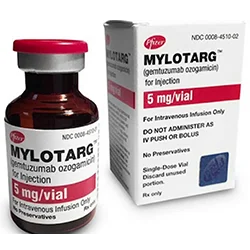
| Mylotarg | gemtuzumab ozogamicin | Acute myeloid (AML) | IV infusion | US FDA |
| Vanflyta | quizartinib | Acute myeloid (AML) | Tablet | US FDA |
| Xospata | gilteritinib | Acute myeloid (AML) | Tablet | US FDA |
| Idhifa | enasidenib | Acute myeloid (AML) | Tablet | US FDA |
| Komzifti | ziftomenib | Acute myeloid (AML) | Capsule | US FDA |
| Revuforj | revumenib | Acute myeloid (AML), Acute lymphoblastic (ALL) | Tablet | US FDA |
| Inqovi | decitabine + cedazuridine | Acute myeloid (AML) | Tablet | US FDA |
| Blincyto | blinatumomab | Acute lymphoblastic (ALL) | IV infusion | US FDA |
| Iclusig | ponatinib | Acute lymphoblastic (ALL), Chronic myeloid (CML) | Tablet | US FDA |
| Atriance | nelarabine | Acute lymphoblastic (ALL) | IV infusion | US FDA (as Arranon) |
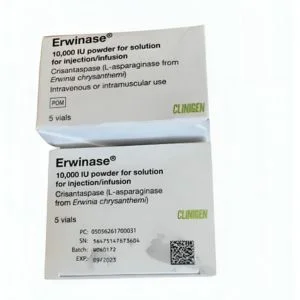
| Erwinase | asparaginase Erwinia chrysanthemi | Acute lymphoblastic (ALL) | Injection | UK / Europe |
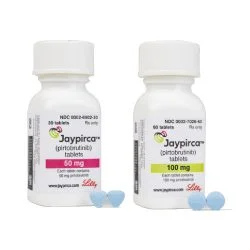
| Jaypirca | pirtobrutinib | Chronic lymphocytic (CLL) | Tablet | US FDA |
| Lisaftoclax | lisaftoclax | Chronic lymphocytic (CLL) | Tablet | China NMPA |
| Sonrotoclax | sonrotoclax | Chronic lymphocytic (CLL) | Tablet | China NMPA |
Reports to keep ready before the prescription
| Report | Why the doctor needs it |
|---|---|
| Bone marrow aspirate and biopsy | Confirms the leukemia type and the share of blast cells |
| Flow cytometry (immunophenotyping) | Separates B-cell from T-cell ALL and shows markers such as CD19 or CD33 |
| Cytogenetics and molecular panel | Looks for FLT3, NPM1, IDH2, KMT2A and BCR-ABL1 changes; without these results the gene-based medicines cannot be chosen |
| MRD report | Measurable residual disease after treatment; Blincyto is approved for B-cell ALL in remission with MRD of 0.1% or more |
| Treatment history | Lists earlier chemotherapy cycles, kinase inhibitors or BTK inhibitors, since several approvals apply only after these |
In the AIIMS New Delhi review of CLL care, the authors note that access to molecular profiling is still limited in many parts of India and that this directly affects treatment choice [10]. Ask your centre early where the gene panel will be sent and how long it takes.
Import permit, hospital delivery and cost help
Every consignment is for a single named patient. The patient's application to CDSCO is made on Form 12A, which our pharmacist prepares, and CDSCO then issues the Form 12B permit covering that import. Our Form 12A and 12B guide lists the documents involved.
Blincyto, Mylotarg, Vyxeos, Cytosar, Atriance and Erwinase are given in hospital, so the shipment can be sent straight to the hospital pharmacy. How the cold chain is kept on the way is described on the hospital delivery in India page. Most of the targeted tablets and capsules on this page are taken at home.
Leukemia treatment often runs in several phases over months or years. Company access schemes and charitable help that some families use are gathered in the support and access programs section of our site.
How to get these leukemia medicines in India
Prescription
Your doctor prescribes the medicine.
Share documents
Send the prescription and latest reports through Online Order.
Import paperwork
Our team checks the source and the import permissions.
Delivery
Delivered with the right storage, including cold chain.
Read How to Order and Indian import regulations. We also serve patients in Delhi NCR, Bangalore, Chennai, Mumbai, Kolkata, Hyderabad and Pune.
Has your doctor prescribed one of these medicines?
Share the prescription and we will guide you on availability and next steps.
Read more about leukemia
- Acute lymphoblastic leukemia (ALL): a complete guide
- FDA approves Jaypirca for previously untreated CLL and SLL
- What is cancer? Types, causes, symptoms, stages and treatment
- All Hematology medicines
References
- IARC Global Cancer Observatory. GLOBOCAN 2024 – India fact sheet (September 2026). https://gco.iarc.who.int/media/globocan/factsheets/populations/356-india-fact-sheet.pdf
- IARC Global Cancer Observatory. GLOBOCAN 2024 – Leukaemia fact sheet (July 2026). https://gco.iarc.who.int/media/globocan/factsheets/cancers/36-leukaemia-fact-sheet.pdf
- Kapoor G et al. Profile of childhood cancers from hospital-based cancer registries in India, 2012-19. Indian Pediatr. 2024;61(1):39-44. https://pubmed.ncbi.nlm.nih.gov/38183250/
- Bhattacharyya J et al. Prevalence and clinical significance of FLT3 and NPM1 mutations in acute myeloid leukaemia patients of Assam, India. Indian J Hematol Blood Transfus. 2018;34(1):32-42. https://pubmed.ncbi.nlm.nih.gov/29398797/
- Borker AS, Kanani DJ. Outcomes of acute lymphoblastic leukemia in children and young adults treated with a Berlin-Frankfurt-Münster-based protocol in a tertiary care multispecialty government hospital. Indian J Cancer. 2026;63(2):153-159. https://pubmed.ncbi.nlm.nih.gov/42714196/
- Jain P et al. Outcomes of adults age 40 years and older with newly diagnosed ALL: a multicenter registry analysis from the Hematology Cancer Consortium. JCO Glob Oncol. 2026;12(7):e2600090. https://pubmed.ncbi.nlm.nih.gov/42525909/
- Srinivasan S et al. Cost-effectiveness of treating childhood acute myeloid leukemia at a tertiary care center in North India. Pediatr Blood Cancer. 2024;71(11):e31242. https://pubmed.ncbi.nlm.nih.gov/39126354/
- Phukan A et al. Efficacy and safety profile of generic imatinib in patients with newly diagnosed chronic myeloid leukemia-chronic phase: experience from eastern India. Ann Hematol. 2021;100(1):85-96. https://pubmed.ncbi.nlm.nih.gov/33025163/
- Bansal S et al. Chronic myeloid leukemia data from India. Indian J Med Paediatr Oncol. 2013;34(3):154-158. https://pubmed.ncbi.nlm.nih.gov/24516297/
- Sahni S et al. Chronic lymphocytic leukemia management in India: balancing evidence, access, and affordability in clinical practice. Front Oncol. 2026;16:1853089. https://pubmed.ncbi.nlm.nih.gov/42528663/
- US FDA prescribing information for each US-approved medicine (DailyMed). https://dailymed.nlm.nih.gov/dailymed/
This page gives general information only and does not replace medical advice. All medicines listed are prescription-only and must be used under a qualified doctor.