

Myelofibrosis and MDS Medicines in India: Imported Options for Bone Marrow Disorders
Myelofibrosis, MDS and their relatives: how they differ
All four conditions on this page start in the stem cells inside the bone marrow, the cells that give rise to red cells, white cells and platelets. They are grouped together here because a haematologist often has to tell them apart, and because some of them change over time. Polycythemia vera (PV) and essential thrombocythemia (ET) can, over time, turn into myelofibrosis; doctors then call it post-PV or post-ET myelofibrosis.
| Condition | What goes wrong in the marrow | What the patient usually notices | Medicine groups on this page |
|---|---|---|---|
| Myelofibrosis (MF) | Fibrous scar tissue builds up, so blood is made in the spleen and liver instead | A swollen spleen with a heavy or painful belly, tiredness from anaemia, fever, night sweats, weight loss | JAK inhibitor tablets and capsules |
| Myelodysplastic syndromes (MDS) | The marrow is busy but the cells it releases are misshapen and die early | Low counts: breathlessness, repeated infections, easy bruising; many need regular transfusions | An oral hypomethylating tablet |
| Polycythemia vera (PV) | Too many red cells, often with extra white cells and platelets | Headaches, itching after a warm bath, a full feeling under the left ribs, clots in veins or arteries | Long-acting interferon injection |
| Essential thrombocythemia (ET) | Too many platelets | Often found on a routine blood test; some have clots or bleeding | Long-acting interferon, a platelet-lowering capsule |
What Indian hospital studies tell us
There is no national registry for these disorders in India, and GLOBOCAN does not count them separately, so the best picture comes from large hospitals.
- MDS appears earlier in life. At Christian Medical College, Vellore, the 936 adults diagnosed with primary MDS between 2003 and 2017 had a median age of 53, and 65% were men [1]. SGPGI Lucknow reported a median age of 55.5 among its 150 patients, and 64% of them had all three blood counts low when first seen [5].
- Higher-risk chromosome changes are common. In the Vellore group, loss of all or part of chromosome 7 was found in 16.1% and a complex karyotype (three or more changes) in 15% [1]. These results feed into the IPSS-R score that guides treatment.
- Myelofibrosis often follows PV. Of the 154 patients in the INLAND survey, 78 had post-PV myelofibrosis, 51 primary myelofibrosis and 25 post-ET myelofibrosis [3]. Abdominal pain or discomfort (81%), tiredness (77%) and fever (54%) were the leading complaints, and hydroxyurea was the most common treatment.
- PV and ET are often picked up by chance. A Ludhiana centre found the diagnosis was incidental in 56.7% of its MPN patients; median age was 52 for PV and ET and 65.5 for myelofibrosis [6].
- Driver gene results match the rest of the world. Among 50 primary myelofibrosis patients at KEM Hospital, Mumbai, 64% carried JAK2, 26% CALR and 2% MPL, while 8% had none of the three ("triple negative") [7].
Where each imported medicine fits
Ruxolitinib, the first JAK inhibitor, has been approved in India since 2013 [3]. The JAK inhibitors listed below are for situations where the haematologist wants a different option, for example when the platelet count is very low, when anaemia is the main problem, or when ruxolitinib has stopped working. The blood count often decides the choice:
| Situation in the report | Medicine approved for it |
|---|---|
| Intermediate or high-risk myelofibrosis where platelets are under 50 × 109/L | Vonjo (pacritinib), under US accelerated approval |
| Intermediate or high-risk myelofibrosis with anaemia | Ojjaara (momelotinib), sold in Europe as Omjjara |
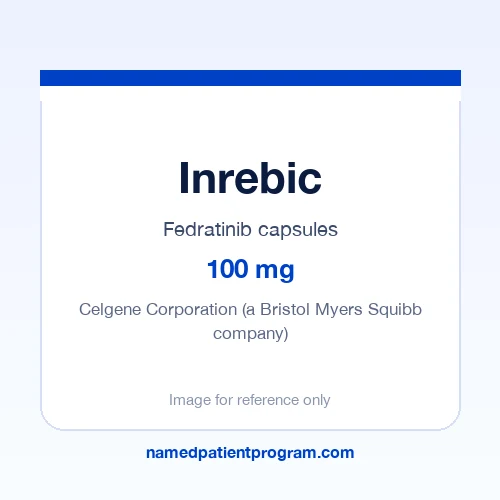
| Myelofibrosis scored intermediate-2 or high risk; the usual starting dose is for platelets of 50 × 109/L or more | Inrebic (fedratinib) |
| Intermediate or high-risk myelofibrosis with a large spleen or symptoms (China approval) | Gecacitinib |
| MDS or CMML scored intermediate-1 or higher on the IPSS | Inqovi (decitabine + cedazuridine) |
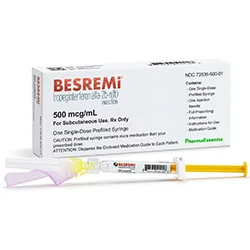
| Adults with polycythemia vera or essential thrombocythemia | Besremi (ropeginterferon alfa-2b) |
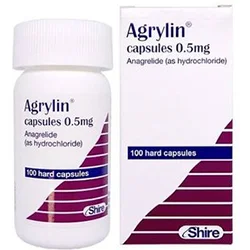
| High platelets caused by a myeloproliferative neoplasm, to lower clot risk | Agrylin (anagrelide) |
Inqovi is worth knowing about for families who travel far for treatment: decitabine, which normally means an infusion, comes here as a tablet swallowed once daily on days 1 to 5, repeated every 28 days.
Imported myelofibrosis and MDS medicines by type
All 7 medicines below are prescription-only. Tap a type to filter. Each card opens the full medicine page with dosage, storage and safety details.




Compare all 7 myelofibrosis and MDS medicines
| Medicine | Generic name | Myelofibrosis and MDS type | Form | Approved by |
|---|---|---|---|---|
| Vonjo | pacritinib | Myelofibrosis | Capsule | US FDA |
| Ojjaara | momelotinib | Myelofibrosis | Tablet | US FDA |
| Inrebic | fedratinib | Myelofibrosis | Capsule | US FDA |
| Gecacitinib | gecacitinib (jaktinib) | Myelofibrosis | Tablet | China NMPA |
| Inqovi | decitabine + cedazuridine | MDS | Tablet | US FDA |
| Besremi | ropeginterferon alfa-2b | Polycythemia vera, Essential thrombocythemia | Subcutaneous injection | US FDA |
| Agrylin | anagrelide | Essential thrombocythemia | Capsule | US FDA |
Tests your haematologist will want first
| Report or test | What it decides | Relevant medicines |
|---|---|---|
| Bone marrow biopsy with karyotype | Confirms the diagnosis and the chromosome changes used in the MDS risk score | Inqovi |
| Risk score (DIPSS for myelofibrosis, IPSS for MDS) | Each approval names the risk groups it covers | Inrebic, Vonjo, Ojjaara, Gecacitinib, Inqovi |
| JAK2, CALR and MPL gene tests | Support the diagnosis of an MPN and help with outlook | All MPN medicines on this page |
| Complete blood count with platelets | The platelet count separates Vonjo use from the usual Inrebic dose; haemoglobin points towards Ojjaara | Vonjo, Inrebic, Ojjaara |
| Vitamin B1 (thiamine) level | The Inrebic label carries a boxed warning for encephalopathy, including Wernicke's; thiamine must be checked and corrected before the first dose and given daily during treatment | Inrebic |
| ECG and clotting tests | The Vonjo label asks for both before the first dose; the Agrylin label asks for a heart check with an ECG beforehand | Vonjo, Agrylin |
| Mental health and autoimmune history | Interferon products carry a boxed warning for serious psychiatric, autoimmune, ischaemic and infection problems | Besremi |
Where a stem cell transplant comes in
For myelofibrosis, an allogeneic (donor) stem cell transplant is still the only treatment that can clear the disease, but it carries real risk. A Delhi transplant centre reported on 15 patients: 60% were alive and free of disease at a median follow-up of about one year, and 40% died of transplant-related causes, mostly infection [8]. Medicines on this page can control symptoms and blood counts before, or instead of, that step. For MDS that turns into acute leukaemia, see our leukemia medicines page.
Import permit, cold-chain delivery and paying for treatment
Six of these seven medicines are tablets or capsules taken by mouth. Besremi is different: its pens must stay between 2 °C and 8 °C, so it travels with a temperature logger, and our delivery to the treating hospital keeps it cold until the hospital pharmacist signs for it. Whichever medicine is chosen, the import permit is the patient's own: a Form 12A application to CDSCO, which our pharmacist drafts on the patient's behalf, after which CDSCO grants a Form 12B permit; the Form 12A and 12B guide lists the papers.
JAK inhibitors and interferon are usually taken month after month, so cost matters. For help from drug makers, government schemes or charities, read our guide to patient support and access programs.
How to get these myelofibrosis and MDS medicines in India
Prescription
Your doctor prescribes the medicine.
Share documents
Send the prescription and latest reports through Online Order.
Import paperwork
Our team checks the source and the import permissions.
Delivery
Delivered with the right storage, including cold chain.
Read How to Order and Indian import regulations. We also serve patients in Delhi NCR, Bangalore, Chennai, Mumbai, Kolkata, Hyderabad and Pune.
Has your doctor prescribed one of these medicines?
Share the prescription and we will guide you on availability and next steps.
Read more about myelofibrosis and MDS
References
- Srivastava VM et al. Higher prevalence of poor prognostic markers at a younger age in adult patients with myelodysplastic syndrome – evaluation of a large cohort in India. Mol Cytogenet. 2024;17(1):21. https://pubmed.ncbi.nlm.nih.gov/39334460/
- El-Fattah MA. Clinical features and outcomes of 666 cases with therapy-related myelodysplastic syndrome (t-MDS). Indian J Hematol Blood Transfus. 2018;34(1):83-90. https://pubmed.ncbi.nlm.nih.gov/29398804/
- Chakrabarti P et al. A comprehensive overview of patient journey and management decision pathway for myelofibrosis in India: INLAND survey. BMC Cancer. 2025;25(1):1164. https://pubmed.ncbi.nlm.nih.gov/40640746/
- Chakrabarti P et al. Assessing myelofibrosis burden on QoL and productivity from healthcare personnel and patient perspectives in India. BMC Cancer. 2025;25(1):1097. https://pubmed.ncbi.nlm.nih.gov/40597945/
- Gupta R et al. Clinico-pathological spectrum and novel karyotypic findings in myelodysplastic syndrome: experience of tertiary care center in India. Mediterr J Hematol Infect Dis. 2017;9(1):e2017048. https://pubmed.ncbi.nlm.nih.gov/28894557/
- Singh S et al. Distinctive attributes of Indian patients with classical BCR::ABL1 negative myeloproliferative neoplasms. Clin Lymphoma Myeloma Leuk. 2023;23(5):360-369. https://pubmed.ncbi.nlm.nih.gov/36849307/
- Patil VR et al. Mutation profile in Indian primary myelofibrosis patients and its clinical implications. South Asian J Cancer. 2019;8(3):186-188. https://pubmed.ncbi.nlm.nih.gov/31489296/
- Choudhary D et al. Allogeneic stem cell transplant for myelofibrosis – a retrospective single-center study. Blood Cell Ther. 2023;6(1):5-10. https://pubmed.ncbi.nlm.nih.gov/37324569/
- US FDA prescribing information for each US-approved medicine (DailyMed). https://dailymed.nlm.nih.gov/dailymed/
This page gives general information only and does not replace medical advice. All medicines listed are prescription-only and must be used under a qualified doctor.