

Crohn's Disease and Ulcerative Colitis Medicines in India: Imported Biologic and Tablet Options
How Crohn's disease differs from ulcerative colitis
Both diseases come from an immune system that keeps attacking the lining of the gut. They are grouped together because they share symptoms and many medicines, yet they behave differently, and the difference shapes treatment.
| Feature | Crohn's disease | Ulcerative colitis |
|---|---|---|
| Part of the gut | Anywhere from mouth to anus, most often the end of the small intestine and the colon, with healthy patches in between | Only the large intestine (colon and rectum), starting at the rectum and spreading upwards without gaps |
| Depth of damage | Can run through the full thickness of the bowel wall | Stays in the inner lining |
| Common complaints | Belly pain, diarrhoea, weight loss, sometimes fistulas or abscesses near the anus | Loose motions with blood or mucus, urgency, cramps |
| Typical complications | Narrowing (strictures) that block the bowel, fistulas, need for surgery | Severe flares with heavy bleeding; long-standing disease raises the risk of colon cancer |
In an Indian series of 182 Crohn's patients, the commonest complaints were loose motions in 68%, belly pain in 62% and losing weight in 57%, and 36% had needed an operation [2].
What Indian studies tell us about IBD
- It is not rare here. The Punjab survey found 44.3 cases of ulcerative colitis per 1,00,000 people and 6.02 new cases per 1,00,000 per year; the authors noted this is not far below Europe and North America [1].
- It is growing. Global Burden of Disease figures put India's 2019 IBD prevalence at 20.34 per 1,00,000 against 59.25 worldwide, but the yearly change in new cases was +0.05 in India while it was −0.18 globally [3]. AIIMS researchers expect India to carry one of the largest IBD burdens on earth [5].
- Children are affected too. At one Gurugram centre, ulcerative colitis made up 60% and Crohn's 35% of 126 children with IBD, and 12.7% had very early onset IBD [4].
- Family history is uncommon. Unlike in Western patients, very few Indian IBD patients have a relative with the disease [5], so a negative family history does not rule it out.
Crohn's or intestinal TB: why diagnosis can take years
Intestinal tuberculosis can look almost the same as Crohn's disease on a scope and on a scan. Because TB is common in India, many patients first receive a full course of anti-TB drugs. In the multicentre study above, 43% of Crohn's patients had taken anti-TB treatment before the right diagnosis was made [2]. Among children with Crohn's at the Gurugram centre, the median time to diagnosis was 52.5 months [4].
There is some good news. That same paediatric study saw empirical anti-TB use in Crohn's fall from 90% in the first decade to 5.8% in the second, and the time to diagnosis drop from 90 months to 21 months [4]. A Mumbai hospital that reviewed 15 years of records saw 348 people with Crohn's and 224 with intestinal TB, and the two did not rise and fall together [6]. TB still matters after diagnosis: every medicine on this page lowers some immune defences, so a TB check comes before the first dose.
Where imported biologics and JAK tablets fit in
Most Indian patients start on medicines that are easy to find here. In the Indian Crohn's series, 70% had received aminosalicylates, 42% steroids and 29% azathioprine [2]. The medicines on this page are for disease that is moderately to severely active, the wording used in every one of their US approvals. They act on different parts of the immune response:
- Anti-TNF: Humira blocks tumour necrosis factor, one of the main signals that drives gut inflammation.
- Gut-selective integrin blocker: Entyvio stops white blood cells from moving out of the blood into the lining of the gut.
- IL-23 blocker: Skyrizi switches off interleukin-23, a messenger that keeps inflammation going.
- JAK inhibitor tablet: Rinvoq is taken by mouth and dampens several signals inside immune cells at once. Its US approval in IBD is for people who have already tried at least one TNF blocker, or another approved systemic treatment when TNF blockers are not advisable.
Your gastroenterologist chooses between them after looking at the extent of disease, earlier treatment, infection risk and other health problems.
Imported Crohn's disease and ulcerative colitis medicines by type
All 4 medicines below are prescription-only. Tap a type to filter. Each card opens the full medicine page with dosage, storage and safety details.
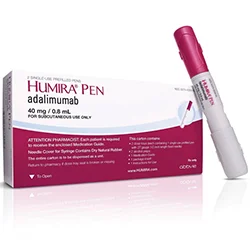

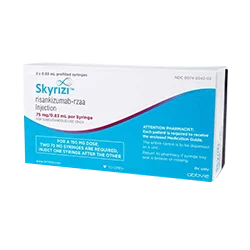

Compare all 4 Crohn's disease and ulcerative colitis medicines
| Medicine | Generic name | Crohn's disease and ulcerative colitis type | Form | Approved by |
|---|---|---|---|---|
| Humira | adalimumab | Anti-TNF | Prefilled pen or syringe (injection under the skin) | US FDA |
| Entyvio | vedolizumab | Gut-selective integrin | IV infusion to start, then prefilled pen | US FDA |
| Skyrizi | risankizumab-rzaa | IL-23 blocker | IV infusion or injection to start, then injection under the skin | US FDA |
| Rinvoq | upadacitinib | JAK inhibitor tablet | Tablet | US FDA |
Checks your gastroenterologist will ask for
| Check | Why the label asks for it | Medicines |
|---|---|---|
| Colonoscopy with biopsy, plus scan if needed | Confirms Crohn's or ulcerative colitis, shows how much of the gut is involved and helps rule out intestinal TB | All four |
| Latent TB test (and chest X-ray) | Humira and Rinvoq labels say to test for latent TB before starting and during treatment; Entyvio and Skyrizi labels say to consider TB testing first | Humira, Rinvoq, Entyvio, Skyrizi |
| Liver enzymes and bilirubin | Needed before Skyrizi is started for Crohn's or ulcerative colitis, and checked again during the first 12 weeks or more | Skyrizi |
| Vaccination record | The Entyvio and Skyrizi labels ask for vaccines to be brought up to date before treatment | Entyvio, Skyrizi |
| Past TNF blocker treatment | Rinvoq's IBD approval applies after a TNF blocker has not worked or was not tolerated | Rinvoq |
| Heart, clot and cancer history | Rinvoq carries a boxed warning covering serious infections, deaths, cancers, heart attacks or strokes, and clots; Humira's boxed warning covers serious infections and cancer | Rinvoq, Humira |
Permits, cold-chain storage and ongoing cost
None of these four is brought in from abroad without paperwork. The Form 12A application goes to CDSCO under the patient's name, with our pharmacist filling it in from the prescription and reports; the Form 12B permit then comes from CDSCO. The contents of both forms are explained on our Form 12A/12B import permit page.
Entyvio, Humira and Skyrizi are biologics, and their labels require refrigeration at 2–8 °C. Entyvio, and Skyrizi for ulcerative colitis, begin with drip infusions given in a hospital or day-care unit; Skyrizi for Crohn's can start either as infusions or as injections. For these, we can ship directly to the hospital's pharmacy in an insulated pack with a temperature recorder, as described under hospital delivery across India. Rinvoq tablets are stored at normal room temperature (2–25 °C, per its label).
IBD medicines are usually continued for years once they work, so plan for cost early. Manufacturer schemes, government programmes and charities that may help are collected on one page: help with treatment costs.
How to get these Crohn's disease and ulcerative colitis medicines in India
Prescription
Your doctor prescribes the medicine.
Share documents
Send the prescription and latest reports through Online Order.
Import paperwork
Our team checks the source and the import permissions.
Delivery
Delivered with the right storage, including cold chain.
Read How to Order and Indian import regulations. We also serve patients in Delhi NCR, Bangalore, Chennai, Mumbai, Kolkata, Hyderabad and Pune.
Has your doctor prescribed one of these medicines?
Share the prescription and we will guide you on availability and next steps.
Read more about Crohn's disease and ulcerative colitis
References
- Sood A, Midha V, Sood N, Bhatia AS, Avasthi G. Incidence and prevalence of ulcerative colitis in Punjab, North India. Gut. 2003;52(11):1587-90. https://pubmed.ncbi.nlm.nih.gov/14570727/
- Das K, Ghoshal UC, Dhali GK, Benjamin J, Ahuja V, Makharia GK. Crohn's disease in India: a multicenter study from a country where tuberculosis is endemic. Dig Dis Sci. 2009;54(5):1099-107. https://pubmed.ncbi.nlm.nih.gov/18770037/
- Giri S, Jena A, Kumar-M P, et al. Burden of inflammatory bowel disease in India: analysis of the Global Burden of Disease study from 1990 to 2019. Intest Res. 2026;24(1):84-94. https://pubmed.ncbi.nlm.nih.gov/39910905/
- Mohan N, Deswal S, Bhardwaj A. Spectrum and trend of pediatric inflammatory bowel disease: a two-decade experience from northern India. Indian J Gastroenterol. 2024;43(1):208-214. https://pubmed.ncbi.nlm.nih.gov/37943479/
- Kedia S, Ahuja V. Epidemiology of inflammatory bowel disease in India: the great shift east. Inflamm Intest Dis. 2017;2(2):102-115. https://pubmed.ncbi.nlm.nih.gov/30018961/
- Dhoble P, Desai D, Abraham P. Is the rise in Crohn's disease in India accompanied by a fall in intestinal tuberculosis? A single-center experience. Indian J Tuberc. 2021;68(2):210-214. https://pubmed.ncbi.nlm.nih.gov/33845954/
- US FDA prescribing information for Entyvio, Humira, Rinvoq and Skyrizi (DailyMed). https://dailymed.nlm.nih.gov/dailymed/
This page gives general information only and does not replace medical advice. All medicines listed are prescription-only and must be used under a qualified doctor.