Call Us for Support
+91 9654860915
Finding access to medicine unapproved in your home country can feel overwhelming. We’re here to help you navigate the process, from your initial request to procurement coordination.
Submit your details and prescription to get started.Register today to get started on your medicine access journey.
Sourced directly from the authorized manufacturer network to ensure authenticity and quality.
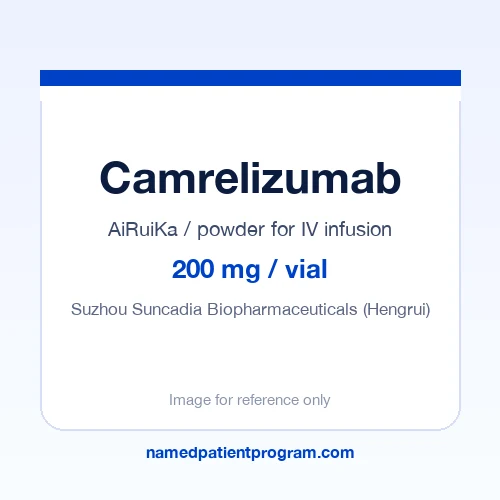
Ready to proceed? Order Camrelizumab on our secure patient portal to submit your prescription, upload documents and track your approval status.
Supplied with complete CDSCO-approved import and customs documentation, including Form 12A & 12B, CDEC, GST Bill of Entry, Commercial Invoice, and Packing List.
Manufacturer / Innovator:
Suzhou Suncadia Biopharmaceuticals Co., Ltd. (Jiangsu Hengrui Pharmaceuticals)
Regulatory Approval:
Your Trustworthy Partner For Named Patient Program
Over a decade of trusted expertise in Named Patient Access to innovative and life-saving medicines.
100% CDSCO-compliant processes ensuring safe, ethical, and responsible medicine access.
Medicines sourced from authorized manufacturers with full batch traceability.
EU-GDP compliant warehousing for secure, quality-controlled global distribution.
Temperature-controlled logistics ensuring safe, reliable, and timely medicine delivery.
Camrelizumab is a PD-1 immunotherapy given as a drip, used in China for liver, lung, oesophageal, nasopharyngeal (back-of-the-nose) and cervical cancers. Jiangsu Hengrui Pharmaceuticals developed it, and its subsidiary Suzhou Suncadia Biopharmaceuticals Co., Ltd. holds the licence and makes it under the brand name AiRuiKa® (艾瑞卡). During development it was known as SHR-1210.
China's National Medical Products Administration (NMPA) first approved it in May 2019, for classical Hodgkin lymphoma that had come back after at least two lines of chemotherapy. Hengrui's July 2026 approval notice lists these current uses:
The right use depends on the exact cancer, its stage and test results, so the oncologist decides whether a patient fits. You can see the other cancer medicines we help import on our oncology page.
T cells, the immune cells that hunt down tumours, carry a switch called PD-1. Many cancers flip this switch to make T cells stand down. This medicine is a humanised IgG4 monoclonal antibody that binds PD-1 and blocks it from meeting its partners PD-L1 and PD-L2, so the T cells can go back to work against the cancer. Lab studies also show a weak binding to VEGFR2, which may be linked to a skin side effect that is typical of this antibody (described under Warnings).
Each vial holds 200 mg of powder, which is dissolved and diluted by the hospital pharmacy before use. As per the Chinese label:
This information is not a treatment plan. For personalized medical advice, consult your doctor and refer to the full prescribing information.
Skin blood-vessel growths (RCEP): the side effect most specific to this antibody is reactive cutaneous capillary endothelial proliferation, small red, raised spots made of tiny blood vessels. In the label's pooled data from 2,011 patients treated alone or with chemotherapy, 76.0% developed them, nearly all grade 1 or 2 (grade 3 in 1.1%). They usually appear in the first month or so and can bleed if knocked. They were far less frequent (27.8%) when the drip was combined with apatinib or famitinib. Tell the team about spots that bleed, get infected, or appear in the mouth, nose or eyes.
Immune-related side effects can affect almost any organ, during treatment or months later. Figures from the same 2,011 patients:
Common side effects when used alone (1,181 patients): besides the skin spots, raised liver enzymes (AST 20.3%, ALT 18.5%), underactive thyroid (17.8%), tiredness (15.6%), anaemia (15.0%), protein in the urine (11.9%) and fever (10.9%). With apatinib or famitinib, raised liver enzymes, low platelets, high blood pressure and diarrhoea were more frequent.
Who should not use it: anyone allergic to the antibody or its other ingredients. Safety in under-18s has not been established, and it is not advised for people with moderate or severe kidney problems because data are lacking. Pregnancy: it should be used only when the expected gain for the mother justifies the possible harm to the baby. Reliable birth control is needed while on treatment and for 2 months after the final infusion, and mothers should not breastfeed during that time either.
Step 1 – Search & request your medicine: The patient or treating doctor submits a request with basic details to initiate the access process.
Step 2 – Verification & eligibility review: The team verifies availability and reviews eligibility against regulatory and clinical requirements to ensure a compliant pathway.
Step 3 – Receive quote & delivery timeline: A transparent quotation is shared, covering medicine cost, logistics, and a clear delivery timeline.
Step 4 – Regulatory approval process: Assistance is provided to secure the approvals and documentation required for legal cross-border access.
Step 5 – Temperature-controlled import & handling: The medicine is sourced and transported under strict GDP-compliant, cold-chain conditions to maintain product integrity.
Step 6 – Secure delivery: The medicine is delivered to the patient or treating hospital, with updates provided at each stage.
Note: From request to delivery, every step is designed to ensure your treatment reaches you safely, compliantly, and without unnecessary delays.
It can be supplied only for a named patient, requested by the patient or the treating hospital, under India's rules for importing unapproved medicines. Please keep these ready:
Once our team has checked the prescription and reports and, where required, the import permit has been issued.
No. CDSCO has not approved it, and we found no Indian approval, expert-committee recommendation or launch. It is not approved by the US FDA or in the European Union either.
Doctors can request it through the Named Patient Program (NPP), which allows one patient to import a medicine that is not registered in India on a prescription. For cervical cancer, its label partner famitinib capsules can be arranged through the same route, and we also handle another China-approved PD-1 antibody, sintilimab.
It can be made available to patients, doctors, and hospitals across major cities in India, including Gurgaon, Delhi, Bangalore, Mumbai, Navi Mumbai, Thane, Hyderabad, Mysore, Kerala, Chennai, Coimbatore, Madurai, Kolkata, Ahmedabad, Surat, Vadodara, Pune, Nagpur, Nashik, Jaipur, Udaipur, Lucknow, Kanpur, Gorakhpur, Chandigarh, Mohali, Faridabad, Noida, Ghaziabad, Kochi, Trivandrum, Kozhikode, Thrissur, Kannur, Mangalore, Bhubaneswar, Patna, Ranchi, Raipur, Guwahati, Visakhapatnam, Vijayawada, Goa, Jammu, Srinagar, Dehradun, Bhopal, Indore, Ludhiana, Amritsar, and others — and can facilitate delivery to the patient's treating hospital. Orders are confirmed only after receipt of a valid doctor's prescription and an import permit, where applicable.
NamedPatientProgram.com (NPP) sources this medicine through the manufacturer's authorised supply channels in China and arranges supply to patients, doctors, and hospitals under applicable legal provisions. The label asks for the vials to be stored and transported at 2°C to 8°C, protected from light and never frozen, so they travel under temperature-controlled shipping with a temperature record for the whole journey. Each 200 mg vial is a single dose for most patients, so we usually plan supply around the two- or three-weekly infusion calendar the oncologist has set. All prescriptions are dispensed and checked by registered pharmacists and dispatched from New Delhi, India, after legal requirements are fulfilled.
For the current cost in India and availability, contact NPP via WhatsApp at +91 98104 69557 | Toll-Free: 1800-1200-365 or email info@namedpatientprogram.com.
Because the vials need a refrigerator from the factory to the infusion room, every delivery is planned around the hospital's cycle date. Once the oncologist's prescription and the import papers are in place, we can serve the cities below and many others.
Hospitals in Delhi treating liver and lung cancer can receive the refrigerated vials quickly, since every shipment is dispatched from New Delhi.
Oncologists in Mumbai can email the prescription and biopsy report, and we confirm the paperwork before the next infusion is booked.
For lung cancer patients in Bangalore on a three-weekly chemotherapy plan, the vial is timed to arrive a day or two before each cycle.
Liver cancer teams in Chennai using the apatinib combination on a two-weekly schedule can receive regular cold-chain deliveries.
Patients in Hyderabad receive a written quote and a delivery plan before anything is ordered.
For hospitals in Kolkata and the north-eastern states, we share the courier and temperature-log details with the family before each refrigerated parcel leaves Delhi.
Cervical cancer patients in Pune whose tumour tests PD-L1 positive can have the request and supporting reports reviewed by our team.
Doctors in Ahmedabad can start a request for oesophageal cancer patients by sharing the scan reports and treatment history.
Head and neck cancer centres in Guwahati can request supply for nasopharyngeal cancer patients, with delivery planned around the longer transit to the north-east.
Patients from Punjab, Haryana and Himachal Pradesh can have the medicine delivered to their cancer centre in Chandigarh.
Hospitals in Lucknow serving patients from across Uttar Pradesh can receive temperature-logged deliveries for each cycle.
Cancer centres in Kochi and Thiruvananthapuram can receive the powder vials for reconstitution by their own oncology pharmacists.
Access can also be coordinated for patients in other Indian cities, subject to a valid prescription and regulatory requirements.
Written By
Nitin GoswamiDeputy Manager – Content & Social Media, Ikris Pharma Network
Sources: NMPA • CDSCO
Last Updated: 19 November 2026
Our specialists are here to guide you through every step of the medicine access process.
Mail Us At:
info@namedpatientprogram.comContact Us:
+91 9654860915Send us a message